Damien Hirst Opens Asia's Largest Solo Retrospective in Seoul
Damien Hirst’s largest solo show in Asia is coming to the National Museum of Modern and Contemporary Art (MMCA) in Seoul. Titled Damien Hirst: Truth is not, but everything is possible, the exhibition runs from May 20 to June 28 at MMCA Seoul and marks Asia’s first major retrospective of the British artist’s four-decade career.
The MMCA describes the show as a moment to illuminate the innovative experiments of an international figure and a space to reflect on modern society’s values and existence. MMCA director Kim Seong-hee said the exhibition offers an opportunity to explore how a global artist has pushed the boundaries of contemporary art.
Curators say the exhibition provides a rigorous, multidimensional view of Hirst’s work, from early pieces to his current painting practice, tracing a 40-year arc. They emphasize that the show examines how Hirst has continually redefined art through themes of death, religion, science and capitalism, and why his approach matters as Korea’s art scene gains global attention.
The survey spans four sections. It begins with works from a young Hirst, including early pieces and the evolution of his iconic Spot Paintings, as the artist helped reshape British contemporary art at the Frieze era’s outset. It then advances to what the curators call the show’s core: a meditation on mortality in the series “The Physical Impossibility of Death in the Mind of the Living” and other works like “A Thousand Years,” which the curators note convey a visceral presence beyond reproduced images.
A highlight of the second section is “The Physical Impossibility of Death in the Mind of the Living,” presented in the formaldehyde-preserved shark piece that has become one of Hirst’s best-known motifs. The display also includes “A Thousand Years,” a work that features a cow head in a process linked to the life-death cycle, in keeping with the show’s focus on life’s brutal cycles.
![Everybody loves a parade !
However, as small as this group appears as it parades down a main street in Seoul, Korea, it is an important one, and the photographer is ready with his camera.
".....The old man on horseback is the official superintendent of the royal stables, and a person of importance. A great deal of ceremony is attached to the appearance in public of any native holding government office, or enjoying high favor at court...."
--- Herbert G. Ponting, Photographer. 1903.
The above quote is from a more complete description of the image found on the reverse of the full stereoview.
On the face of the original stereoview, the photo caption's use of "Grand Master of Horse" was done by an American typesetter, and probably was meant to say "Grand Master of the Horse". Ponting was British, and that's probably the closest thing in [British] English he could come up with to describe the old man's rank : en.wikipedia.org/wiki/Master_of_the_Horse
♥ ORIGINAL DESCRIPTION : www.flickr.com/photos/okinawa-soba/18839259393/
♥ FULL MOUNTED STEREOVIEW : www.flickr.com/photos/okinawa-soba/18837377884/
PHOTO NOTES : Photographed in Korea by Herbert G. Ponting in 1903, first published as a stereoview by UNDERWOOD & UNDERWOOD in 1904.
Between 1902 and 1903, ponting made at least two trips to Korea, and photographed there before the Russo-Japan War broke out in 1904.
He was fortunate to have made these photo excursions to Korea prior to war breaking out, as the resulting images show very little of the Japanese troop presence and war activities.
Further, prior to 1904, Ponting was not subjected to the strict censorship of the Japanese military, who imposed many restrictions on foreign photographers and journalists.
Ponting obtained the slightly elevated camera positions seen in many of his Korean street views by using the tripod-ladder contraption seen HERE :
♥ www.flickr.com/photos/okinawa-soba/2356526873/
Cheers !](https://journalkor.site/content/images/2026/03/02_A_Korean_Drum___Bugle_Corps_Escorts_the_Grand-Master_of_the_Emperor_s_Royal_Stables_Through_Seoul_in_1903.jpg)
In the third section, titled “The Luxury of Silence” in the translation, the show probes how science, medicine and capital shape belief in modern life. The display includes the diamond-studded skull “For the Love of God” and a pharmacy-inspired installation, with a recreated London restaurant called Pharmacy inside the gallery to question how authority and prestige are constructed in visual culture.
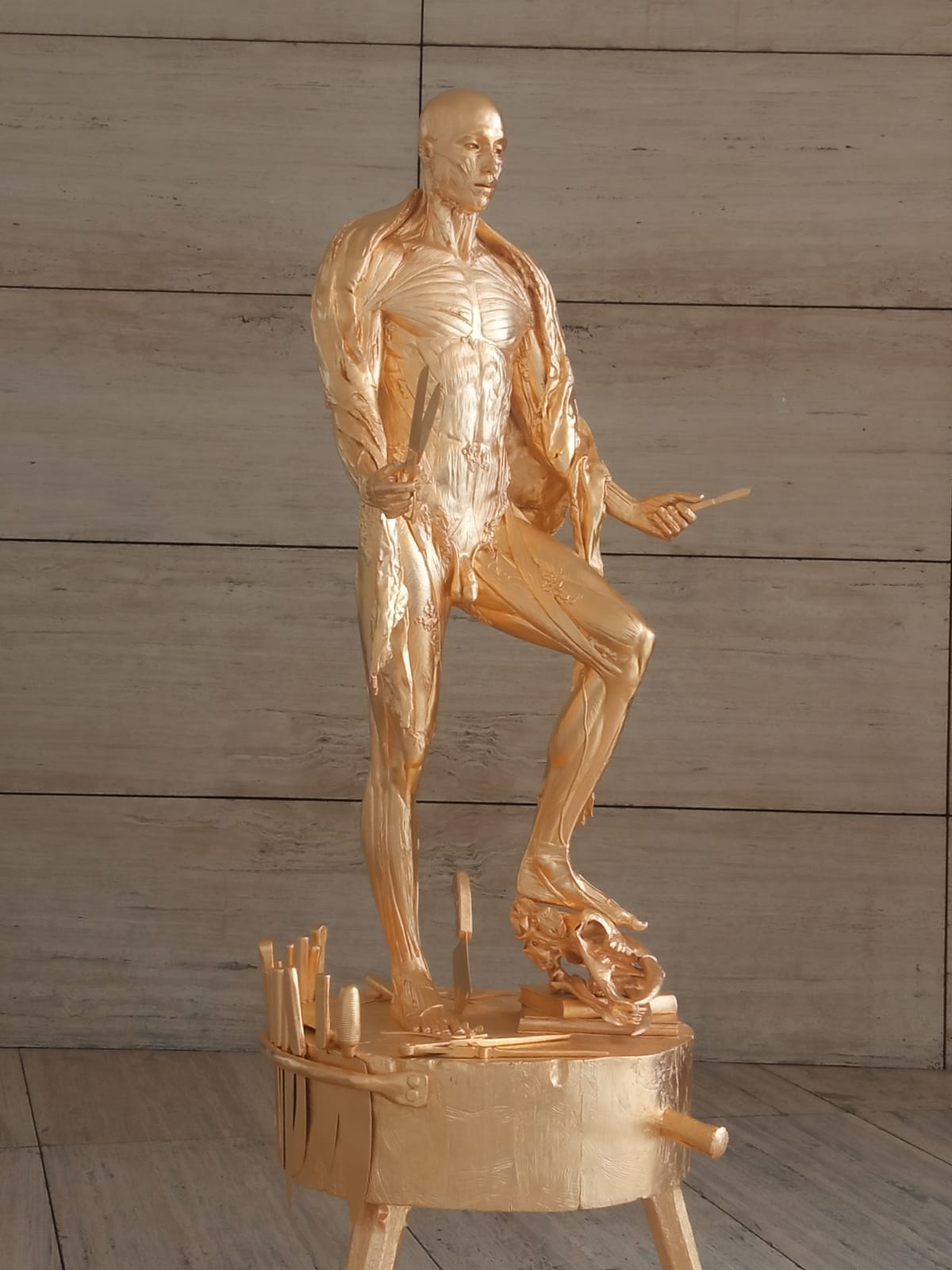
The final part relocates Hirst’s London studio into the gallery, presenting unfinished paintings and the tools of his trade to share the artist’s creative process with viewers. The exhibition culminates with an immersive, reflective look at life, death, and the systems that organize contemporary society.
For U.S. audiences, the Seoul show matters beyond Korea as a window into Korea’s rising role in the global art world and the ways public museums curate controversial figures to spark discourse. It also highlights how major presentations travel and circulate across markets, potentially involving loans, audiences, and media attention that influence global tastes, curatorial trends, and the balance between shock and scholarly context in contemporary art. The exhibition runs through June 28.