Korea's Shinsegae, US-based Reflection AI to build Korea's largest AI data center

Shinsegae Group and Reflection AI of the United States announced a strategic partnership to build what they describe as Korea’s largest AI data center, with an initial target capacity of 250 megawatts. The plan calls for a staged expansion and the establishment of a joint venture this year, following the signing of a memorandum of understanding on the evening of the 16th at the National AI Center in San Francisco.

The signing event was attended by Shinsegae Group Chairman Jung Yong-jin and Reflection AI CEO Misha Laskin, who pledged to advance their collaboration. The two firms said they would move quickly to coordinate with relevant government agencies and local authorities as they proceed.

Under the agreement, the partners plan to develop a full-stack AI factory built around a large data center. The goal is to provide cloud services alongside tailored AI solutions, with an emphasis on offering an AI cloud service that both Korean government agencies and private sector companies can use. This aligns with Korea’s push to strengthen AI competitiveness and build sovereign AI capabilities.
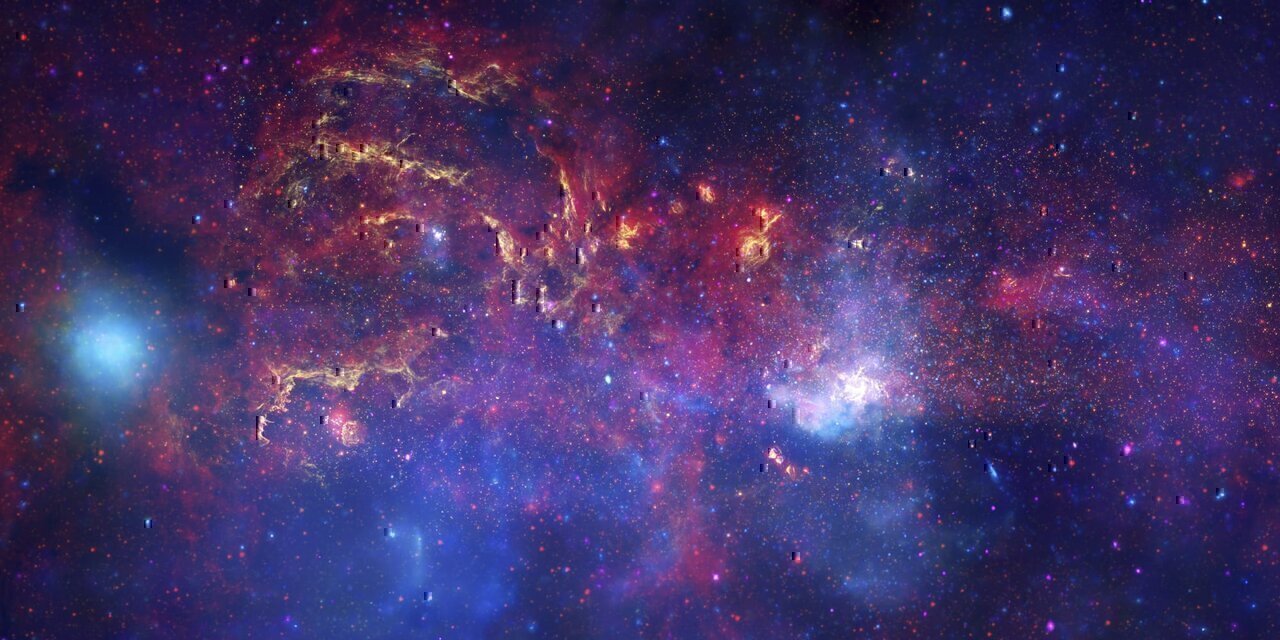
In celebration of the International Year of Astronomy 2009, NASA's Great Observatories -- the Hubble Space Telescope, the Spitzer Space Telescope, and the Chandra X-ray Observatory -- have produced a matched trio of images of the central region of our Milky Way galaxy. Each image shows the telescope's different wavelength view of the galactic center region, illustrating the unique science each observatory conducts.
In this spectacular image, observations using infrared light and X-ray light see through the obscuring dust and reveal the intense activity near the galactic core. Note that the center of the galaxy is located within the bright white region to the right of and just below the middle of the image. The entire image width covers about one-half a degree, about the same angular width as the full moon.
Each telescope's contribution is presented in a different colour:

Yellow represents the near-infrared observations of Hubble. The galactic center is marked by the bright patch in the lower right. Along the left side are large arcs of warm gas that have been heated by clusters of bright massive stars. In addition, Hubble uncovered many more massive stars across the region. Winds and radiation from these stars create the complex structures seen in the gas throughout the image.This sweeping panorama is one of the sharpest infrared pictures ever made of the galactic center region.
Red represents the infrared observations of Spitzer. The swirling core of our galaxy harbors hundreds of thousands of stars that cannot be seen in visible light. These stars heat the nearby gas and dust. These dusty clouds glow in infrared light and reveal their often dramatic shapes. Some of these clouds harbor stellar nurseries that are forming new generations of stars. Like the downtown of a large city, the center of our galaxy is a crowded, active, and vibrant place.
Blue and violet represent the X-ray observations of Chandra. In this image, violet represents lower energy X-rays and blue indicates higher energy. Hundreds of small dots show emission from material around black holes and other dense stellar objects. A supermassive black hole -- some four million times more massive than the Sun -- resides within the bright region in the lower right. The diffuse X-ray light comes from gas heated to millions of degrees by outflows from the supermassive black hole, winds from giant stars, and stellar explosions. This central region is the most energetic place in our galaxy.
When these views are brought together, this composite image provides one of the most detailed views ever of our galaxy's mysterious core.
Representative image for context; not directly related to the specific event in this article. License: Public domain. Source: Wikimedia Commons.

In remarks accompanying the signing, Shinsegae executives described the project as foundational for the group’s future growth and for elevating Korea’s overall AI ecosystem. They said the initiative is intended to support a broader shift toward AI as a future growth engine across the conglomerate and the domestic economy.

A notable public endorsement came from a U.S. official who attended the event, underscoring Washington’s support for the project. The presence of the U.S. Commerce Department figure highlighted a broader context: the partnership is framed as the first technology cooperation under the U.S. government’s AI export program begun last July.

Reflection AI’s leadership emphasized Korea’s status as a global IT powerhouse and stressed a joint effort to develop AI infrastructure that Korea can lead. The two companies also announced that the data center would source its GPUs from Nvidia, a supplier that has attracted significant investment from Reflection AI and other partners in recent years.
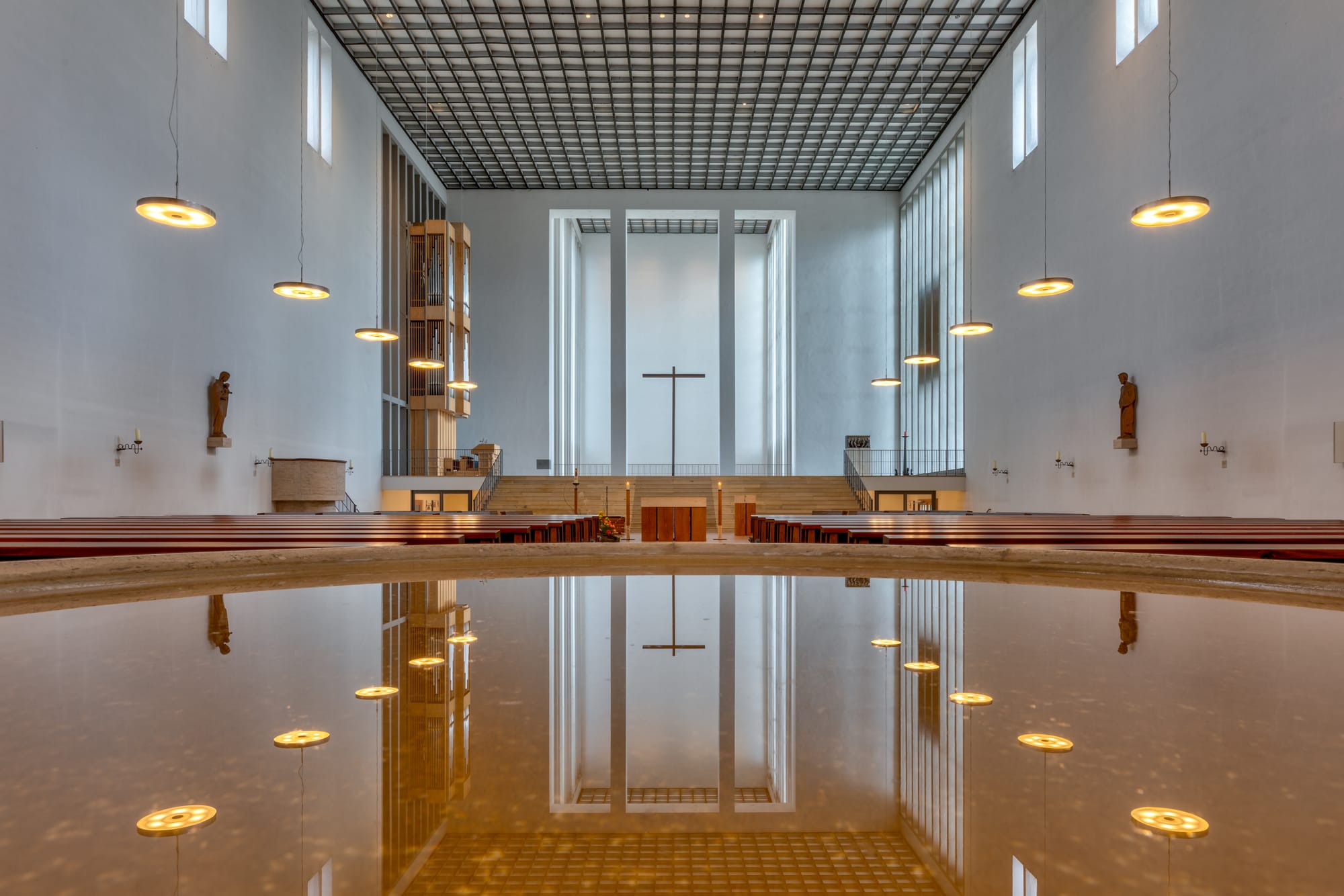
Interior view (with reflections in the stoup, a symbolic baptismal font) of the Holy Cross Church in Dülmen, North Rhine-Westphalia, GermanyThe Holy Cross Church is a Roman Catholic parish church that houses the tomb of the blessed mystic Anna Katharina Emmerick. It was built between 1936 and 1938 on Lüdinghauser Straße by church architect Dominikus Böhm as the second Catholic parish church and was consecrated on November 16, 1938, by the then Bishop of Münster, Clemens August Graf von Galen, as the last new church to be built in Germany before the Second World War. The church was partially destroyed by bombs on March 22, 1945. The building was rebuilt by 1953, although the baptistery was not rebuilt. The church was renovated and redesigned in the 1970s and 2000s.
Representative image for context; not directly related to the specific event in this article. License: CC BY-SA 4.0. Source: Wikimedia Commons.

Nvidia’s participation is significant because GPUs are central to modern AI training and deployment, and the companies’ expectation of reliable GPU supply is tied to recent capital infusions—Reflecting Nvidia’s reported $2 billion investment in AI hardware partnerships last year. The arrangement suggests a strategic overlap of global semiconductor and AI cloud ecosystems with implications for regional and cross-border supply chains.

For U.S. readers, the deal matters for several reasons. It signals deeper cooperation between a major Korean conglomerate and a U.S. AI firm on building advanced AI infrastructure in Asia, with potential implications for cloud markets, data localization, and cross-border technology transfer. It also ties into U.S. policy interests around AI competitiveness, export controls, and the secure, resilient deployment of AI technologies that involve American hardware suppliers and software ecosystems.

Korean authorities and businesses see the project as a potential accelerator of the country’s sovereign AI ambitions, combining domestic cloud services with international investment and technology partnerships. If realized, the data center and its full-stack AI factory could influence regional AI capacity, cloud pricing, and the availability of government-facing AI services in Korea, while contributing to broader U.S.-Korea cooperation in AI research, security, and digital infrastructure.

Subscribe to Journal of Korea

Don’t miss out on the latest issues. Sign up now to get access to the library of members-only issues.
jamie@example.com
Subscribe