U.S.-Iran Strikes Target Kharg Island, Fujairah as Oil Markets Brace for Disruptions

Tensions in the Middle East intensified as the United States and Iran traded major strikes, pushing global oil markets toward new uncertainty. On the morning of the strike, coordination between Washington and its regional allies appeared aimed at curbing Iran’s ability to move crude through key chokepoints near the Persian Gulf, just as oil prices remained sensitive to supply disruptions.

The United States announced it had attacked Iran’s oil-export hub at Kharg Island, claiming more than 90 Iranian military targets were destroyed, including naval mine depots and missile bunkers. President Donald Trump, posting on Truth Social, said U.S. Central Command had carried out the operation under his direction and described it as among the strongest bombings in the region’s history.

Iran’s response followed quickly. Tehran said its forces attacked the United Arab Emirates’ Fujairah port, a crucial oil storage and export facility outside the Hormuz Strait, with Shahid drones. Fire and smoke were reported at storage facilities, but UAE authorities said there were no casualties and that firefighting services contained the blaze, with operations resuming the next day.
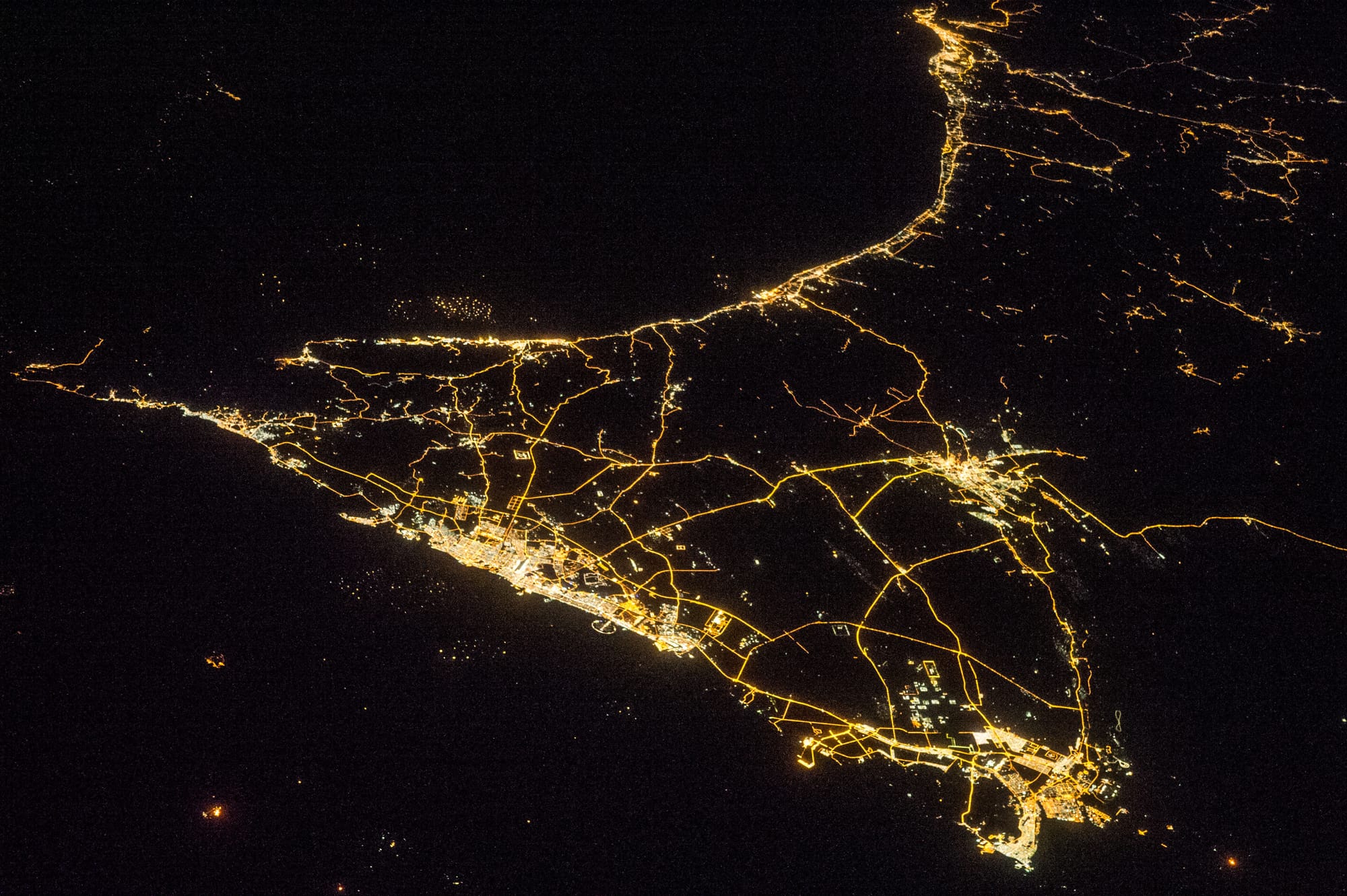
A nighttime view of the United Arab Emirates is featured in this image photographed by an Expedition 38 crew member on the International Space Station.
Geographers like night images of cities because you see immediately so much about the human landscape–things that are difficult or impossible to see in day images. You see where the cities are located and their shape; the brightest light clusters frequently indicate the city centers.
In large field of view images, such as this photograph of the United Arab Emirates (UAE), you can also see cities' position relative to one another and their relative size. Here the largest cluster of lights is the conurbation ("joined cities") of Dubai-Sharjah-Ajman (population 3.25 million), with its smaller neighbor Dubai (population 2.1 million). These cities front onto the Persian Gulf (also known as the Arabian Gulf) where the city lights are cut off abruptly at the coastline. The bright city centers are located at the coast showing that sea trade is important (and has been important) in the growth of these cities.
Smaller cities are Al Ain (population 518,000), the fourth largest city in the UAE, and Fujairah (population 152,000). Major highways join the cities in a brightly lit network, and a faint peppering of lights offshore shows the relatively young oil and gas platforms on either side of the Musandam Peninsula (left). Despite being taken at night, the spike of the Musandam Peninsula is easy to imagine at the south end of the Persian Gulf. The biggest cities in the UAE are Abu Dhabi and Dubai.
Muscat, the capital city of the neighboring country of Oman, appears top center. By contrast, the almost unpopulated Musandam Peninsula shows very few lights.
Representative image for context; not directly related to the specific event in this article. License: Public domain. Source: Wikimedia Commons.

Fujairah’s strategic importance lies in its role as a major oil-export hub outside the Hormuz Strait. Oil shipments from Abu Dhabi’s fields traverse the ADCOP land pipeline to Fujairah, allowing daily exports of up to about 1.8 million barrels and providing an alternative route to Asia and Europe for Middle Eastern crude.

Analysts view the strikes as signaling, with Tehran warning that Iran could strike additional targets inside the UAE if the conflict persists. Iranian officials stated that their sovereignty and territorial integrity would be defended and urged UAE authorities and residents to move away from sensitive locations, highlighting the broader risk to regional stability.
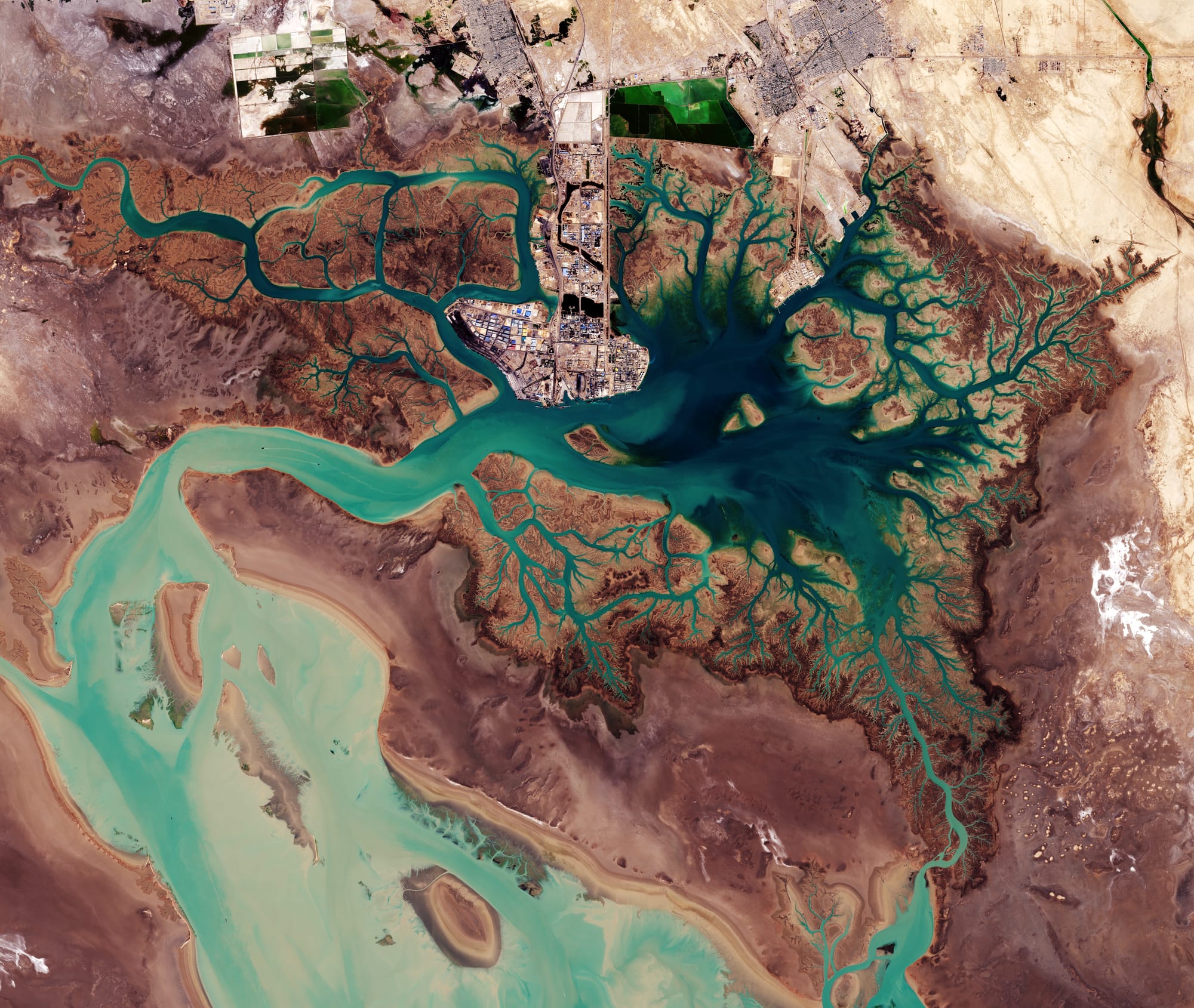
Iran’s Musa Bay (خور موسی) on the northern end of the Persian Gulf is pictured in this image from the Copernicus Sentinel-2A satellite on 13 January 2017.
Near the centre, we can see the port city of Bandar Imam Khomeini, situated at the terminus of the Trans-Iranian Railway – a route that links the Persian Gulf with Iran’s capital, Tehran.
The dark area to the right of the port is Musa Bay, a shallow estuary. The large geometric structures along the top appear to be evaporation ponds for extracting naturally occurring minerals from the ground.
The left side of the image is dominated by the marshes and mudflats of the Shadegan wildlife refuge. It is the largest wetland in Iran, and plays a significant role in the natural ecology of the area.
The area provides a wintering habitat for a wide variety of migratory birds, and is the most important site in the world for a rare species of aquatic bird: the marbled duck. The northern part of the wetland is a vital freshwater habitat for many endangered species.
This area is considered a wetland of international importance by the Ramsar Convention, an intergovernmental treaty for the sustainable use of wetlands.
World Wetlands Day is observed every year on 2 February.

This image is featured on the Earth from Space video programme.
Representative image for context; not directly related to the specific event in this article. License: CC BY-SA 3.0 igo. Source: Wikimedia Commons.

In response to the energy shock, the United States moved to ease some supply pressures. Washington renewed three general licenses allowing certain Venezuela energy-related activities, including the import of petrochemical products such as fertilizers, though final contracts still require approval from the Office of Foreign Assets Control. Separately, U.S. authorities indicated a temporary pause on some Russia oil sanctions to facilitate continued shipments.

The U.S. Embassy in Iraq issued heightened security advisories, ordering nonessential personnel to depart and urging American citizens to leave the country as tensions with Iran-backed groups escalated. The State Department had previously warned of potential attacks on American targets in the region, underscoring a broad risk environment for expatriates and foreign workers.

For U.S. readers, the episode underscores how conflict in the Persian Gulf can shape global energy security and markets. Any escalation involving Iran, the Hormuz Strait, or key export hubs like Kharg Island and Fujairah can quickly influence crude prices, shipping costs, and broader supply-chain stability across Asia, Europe, and North America. Washington’s dual approach—retaliatory action against Iranian targets paired with sanctions-relief signals for continued oil flow—illustrates the high-stakes balance the United States seeks between pressure on Tehran and preventing a spike in global energy costs.

Subscribe to Journal of Korea

Don’t miss out on the latest issues. Sign up now to get access to the library of members-only issues.
jamie@example.com
Subscribe