Cho Kuk Criticizes Han Dong-hoon in Korea's Prosecution Reform Clash

Cho Kuk, the head of the Cho Kuk Innovation Party, directed sharp criticism at Han Dong-hoon, the former leader of the People Power Party, after a Japanese newspaper interview was published. Cho posted about the interview on his Facebook page on the 14th, linking to the Nikkei interview and laying out his critique.

Cho described Han as “the Joseon era’s chief mouthpiece,” a strong rebuke in Korean political rhetoric. He said Han had been at the forefront of political prosecutions during Yoon Suk-yeol’s tenure as prosecutor general, and that he was treated as a crown prince within Yoon’s administration. Cho argued that Han’s self-importance grew because he was selected by the president rather than elected by the people, and he suggested the relationship between Yoon and Han amounted to more of a master-and-pupil dynamic than a partnership.
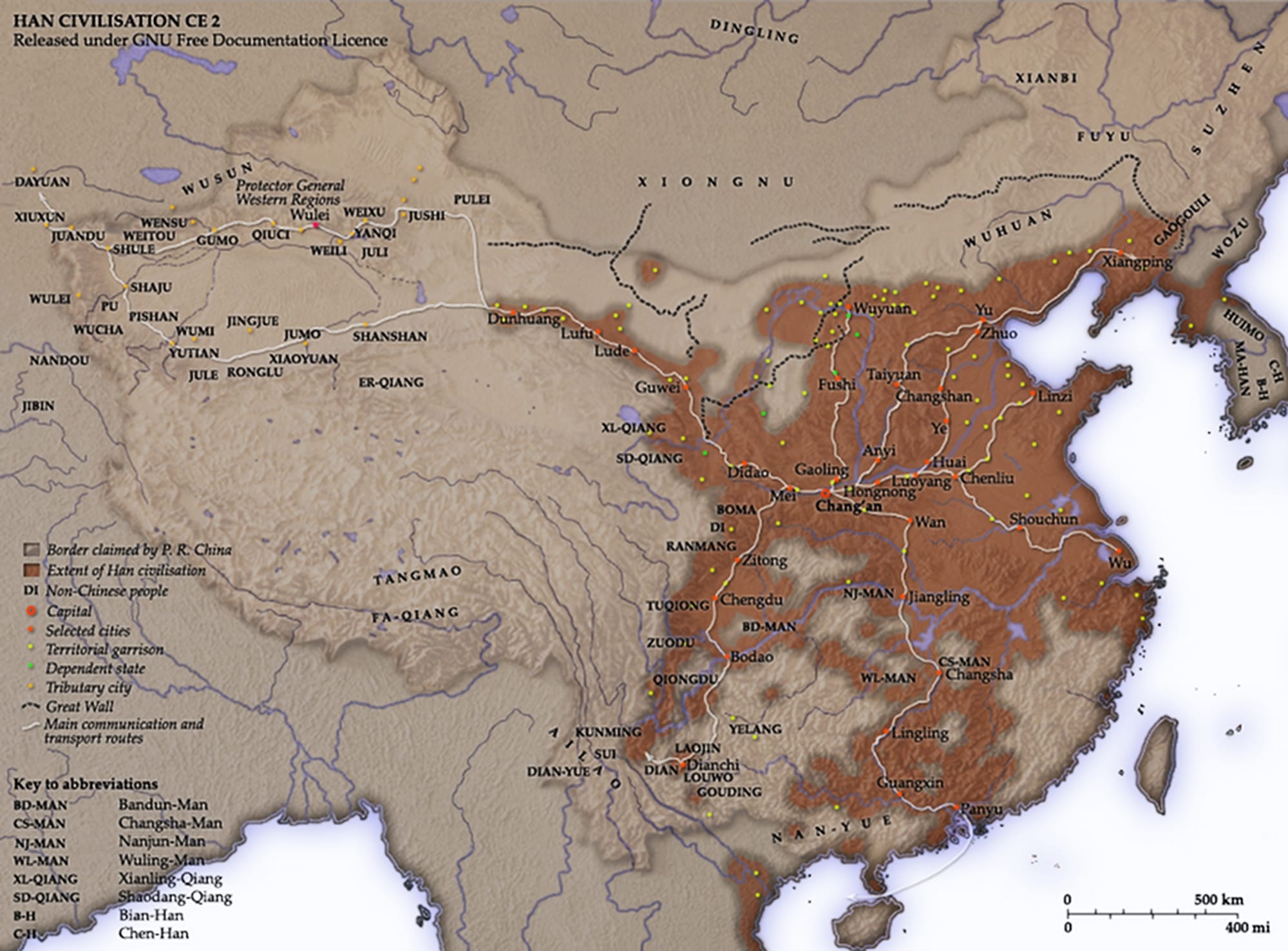
This map shows the world as was known to the Western Han Dynasty (206 BCE – 9 CE) China in 2 CE. The shaded areas show the extent of Han civilisation (206 BCE – 220 CE).  

Contents

1 Notes

1.1 Territorial garrisons
1.2 The Great Wall
1.3 Routes of communication
1.4 The Western Regions
1.5 Transliteration


2 Related images


Notes
Created and copyright (2006) by Yeu Ninje. Released under the GNU FDL.
I've based this on the existence of settlements under direct Han political authority or military control according to Tan Qixiang (ed.), Zhongguo lishi ditu (中国历史地图集; 1982).
The international boundary shown is the border claimed by the en:People's Republic of China. Compare the territories of the historical Han dynasty and the territories over which the modern Chinese state claims sovereignty.
Territorial garrisons
The headquarters of chief commandants (都尉) are shown in yellow. Chief commandants commanded territorial garrisons and were responsible for the supression of local armed threats and supervision of recruitment for military service. 

Note that these were concentrated on the frontiers, especially on the northern border region. When in the interior of the Han empire, they were often placed near iron or salt industries, or on important communication routes.

Dependent states (屬國) are shown in green. These were usually mixed settlements of Chinese and Xiongnu or more commonly, en:Qiang, under Han administration.

The Great Wall
During most of the Western Han period, the en:Great Wall served as a line of demarcation between Han and non-Chinese peoples, most notable of whom were the en:Xiongnu. The line of the Great Wall was extended by Emperor Wu along the en:Gansu corridor (the commanderies based at Dunhuang, Lufu, Lude and Guzang). This, along with walls north of the great loop of the en:Yellow River (beyond Wuyuan), provided the front line defences against the Xiongnu. A second line was maintained along the old Qin wall (the one that passes close to Fushi and Didao), which was important even into the en:1st century. 
Both the lines of the Great Wall and Yellow River are based on Tan Qixiang (ed.), Zhongguo lishi ditu (中国历史地图集; 1982). Note that the Yellow River is considerably to the north of its present flow.

Routes of communication
The broad outline of communication and transport routes from the capital en:Chang'an is marked in white. These were based on en:Qin Dynasty imperial highways, Han roads (such as the Chang'an-Anyi-Taiyuan-Yu road) and navigable riverways (such as the Chenliu and Shouchun route). The long road extending west from Chang'an to the "en:Western Regions" is often known as the en:Silk Road.
These are based in part on the reconstruction of early Chinese roads and waterways by en:Joseph Needham in Science and Civilisation, Vol. IV, (1954), and the additions of en:Rafe de Crespigny in Generals of the South (1992). The northern and southern routes of the Silk Road in the Western Regions is based on Map 16 in Cambridge History of China, vol. 1, (1986).

The Western Regions
From the end of the en:2nd century BC, Han China fought with the Xiongnu over control of the Western Regions. By the time that they established the office of Protector General of the Western Regions (at Wulei) in en:60 BC or en:59 BC, the entire region was dominated by the Chinese. Tributary city-states, in light orange, sent periodic tribute to Chang'an and were rewarded by the Han court.

Transliteration
Names of non-Chinese peoples and states have been purposely left with their Chinese names (e.g. Dayuan instead of en:Fergana; Gaogouli instead of en:Goguryeo) to reflect the fact that our knowledge of participants in the Han world order comes almost exclusively from Chinese sources. Chinese names are transliterated by en:pinyin (e.g. Dayuan instead of Ta-yuan).
Transliteration of non-Chinese peopes and states follows the pronunciation guides given in the Hou Han shu. They often diverge from the Mandarin pronunciations which are now standard:
婼羌 Er-Qiang; 鄯善 Shanshan; 且末 Jumo; 小宛 Xiao-Yuan; 精絕 Jingjue; 戎盧 Ronglu; 扜彌 Wumi; 渠勒 Jule; 于闐 Yutian; 皮山 Pishan; 烏秅 Wucha; 西夜 Xiye (Xiyi); 蒲 Pu; 依耐 Yinai; 無雷 Wulei; 難兜 Nandou; 罽賓 Jibin; 烏弋山離 Wuyishanli; 安息 Anxi; 大月氏 Da-Yuezhi; 康居 Kangju; 大宛 Da-Yuan; 桃槐 Taohui; 休循 Xiuxun; 捐毒 Juandu; 莎車 Shaju; 疏勒 Shule; 尉頭 Weitou; 龜茲 Qiuci; 姑墨 Gumo; 焉耆 Yanqi.

Related images


			Qin empire (210 BC)


			Ming civilisation (1580)
Representative image for context; not directly related to the specific event in this article. License: CC BY-SA 3.0. Source: Wikimedia Commons.

In his broader critique, Cho argued that Han only realized Yoon intended to undermine him after the fact, and he claimed that those who had supported impeaching Han in the past later supported him for reasons tied to self-interest. Cho said this showed a pattern of manipulation that the public deserved to understand.

Cho also pointed to Han’s remarks about the arrest motion against Lee Jae-myung, a prominent opposition figure, saying Han framed Lee as the apex of large-scale corruption and argued for detention in the National Assembly. Cho challenged whether such assertions remained justified and urged the public to demand an explanation from Han.

The exchange comes after the Nikkei interview, published in Japan, which cited Han’s views on prosecutorial reform and political accountability. Cho’s Facebook post recaps and intensifies the dispute, presenting it as a clash over loyalty, credibility, and the proper role of prosecutors in politics.

Cho Kuk Criticizes Han Dong-hoon in Korea's Prosecution Reform Clash
Representative image for context; not directly related to the specific event in this article. License: Public domain. Source: Wikimedia Commons.

For international readers, the episode illuminates Korea’s high-stakes political battle over the judiciary and anti-corruption efforts that have long framed elections and governance. The feud involves figures who shaped or influenced criminal investigations, the legal reforms touted by the ruling party, and responses from the main opposition.

South Korea remains a pivotal U.S. ally in security, technology, and regional economics. Periods of political contention over prosecutorial power and impeachment arguments can influence policy directions, judicial independence debates, and investor confidence in a country that is central to global supply chains for semiconductors and other advanced technologies. How these debates unfold can affect not only domestic governance but also the climate for U.S.–Korea cooperation on security, trade, and technology policy.

Subscribe to Journal of Korea

Don’t miss out on the latest issues. Sign up now to get access to the library of members-only issues.
jamie@example.com
Subscribe