South Korea Faces Unhealthy PM2.5 as Cross-Border Dust Returns

Spring-like conditions are returning to the Korean peninsula, with milder daytime temperatures forecast around 15C, but mornings will remain chilly, producing a notable day-to-night temperature swing.

Starting tomorrow, a springtime pollutant remains a concern. The air is already stagnant, and a new influx of fine dust is expected to ride in on northwest winds from abroad. By the afternoon, PM2.5 levels are forecast to reach the "unhealthy" or similar high category across most regions.
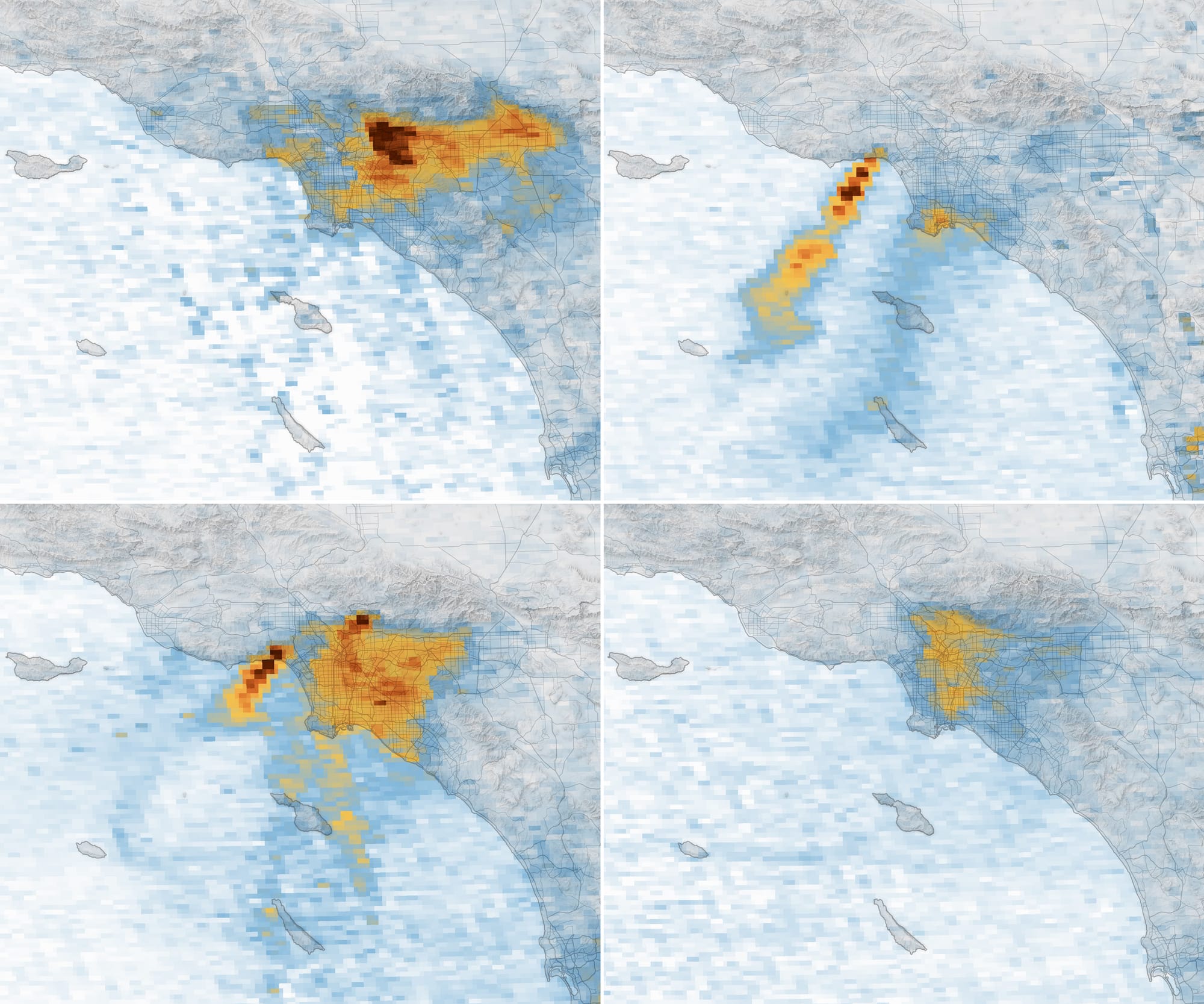
As people in Los Angeles went through the day on January 6, 2025, NASA’s TEMPO (Tropospheric Emissions: Monitoring of Pollution) sensor performed hourly east-to-west scans of North America. From its geostationary orbit 22,000 miles (35,000 kilometers) away, the pollution-measuring satellite observed the city's normal daily signature—a plume of nitrogen dioxide (NO2) emerging during the morning commute and lingering over the city for the rest of the day.
“On the day before the fire, NO2 built up hour by hour, and, like clockwork, drifted east in afternoon sea breezes, as we’ve observed it most days,” said Laura Judd, an atmospheric scientist at NASA’s Langley Research Center. Motor vehicles are major sources of the gas in Los Angeles, though other main sources include power plants, port facilities, and industrial sites.
Air quality experts consider the reddish-brown gas, primarily a byproduct of fossil fuel combustion, to be hazardous to human health. It also contributes to the formation of ground-level ozone and particulate matter, also health hazards. The image above (upper left) shows NO2 over the city at 1:50 p.m. Pacific Time on January 6. It is one of nine images of the Los Angeles area captured by TEMPO over the course of the day and dozens more in the days that followed, some of which are shown above.
January 7 brought an ominous change in the weather. Strong Santa Ana winds streamed from the northeast, pushing the normal emissions that formed over the city that morning farther over the Pacific Ocean. As the morning progressed, a small source of NO2 sprung up west of downtown Los Angeles over the Pacific Palisades neighborhood. By the afternoon (upper right), winds had pushed the gas to the southwest, creating two distinct parallel plumes.
The source of the more westerly plume was the Palisades fire, now the fourth most destructive fire on record in California. By the afternoon of January 9 (lower left), another large wildland fire, the Eaton fire, raged near Pasadena, northeast of Los Angeles. The westward blowing winds caused NO2 to stream over the heart of the city on its way out to sea.
TEMPO detected particularly strong NO2 plumes as the fires raged between January 8 and 11. By January 12 (lower right), firefighters had made enough progress that the NO2 signal from the fires waned and urban pollutants began to dominate emissions again. As of January 16, Cal Fire reported the Palisades fire was 27 percent contained, and the Eaton fire was 55 percent contained.
“This is a map of NO2, but we know it was accompanied by a variety of other trace gases and airborne particulates also found within wildland fire smoke plumes,” said Aaron Naeger, an atmospheric scientist with the Short-term Prediction Research and Transition Center at NASA’s Marshall Space Flight Center. Among them: elevated levels of carbon monoxide, formaldehyde, and fine particulate matter (PM2.5).
The Environmental Protection Agency’s AirNow program and the South Coast Air Quality Management District provide localized, nose-level information about air quality collected from ground monitors while TEMPO collects complementary columnar NO2 data with broad spatial coverage from its vantage point in orbit.
Researchers are currently working on feeding TEMPO data into national and state air quality monitoring and forecasting systems, but TEMPO observations of NO2 and formaldehyde are already being ingested into data browsing platforms from NASA Worldview, SPoRT, and the Harvard-Smithsonian Center for Astrophysics and used by researchers and others.
People in the vicinity of an NO2 plume mapped by TEMPO can enter their zip code into AirNow and get more details about local air quality conditions, said Naeger. During the height of the burning, AirNow data indicated that several neighborhoods in Los Angeles faced unhealthy air.

NASA Earth Observatory image by Michala Garrison, using TEMPO data from NASA Earthdata. Story by Adam Voiland.
Representative image for context; not directly related to the specific event in this article. License: Public domain. Source: Wikimedia Commons.

The weather over the weekend will be unsettled. Sunday is expected to be cloudy nationwide, with a chance of light rain or snow flurries in inland areas. In the morning, fog may linger in western parts. In the afternoon, lower cloud cover will reduce visibility in the Gangwon mountain region.

Temperature-wise, mornings will run above seasonal norms for many areas. Look for around 4C in Seoul and Daegu, and about 3C in Gwangju. Daytime highs are projected to reach roughly 13C in Seoul and 14C in Daegu.

The forecast underscores a recurring spring air-quality challenge in Korea: stagnant air combined with cross-border dust and pollutants transported by wind from outside the peninsula. This episode highlights the difficulty of managing PM2.5 exposure during seasonal transitions.
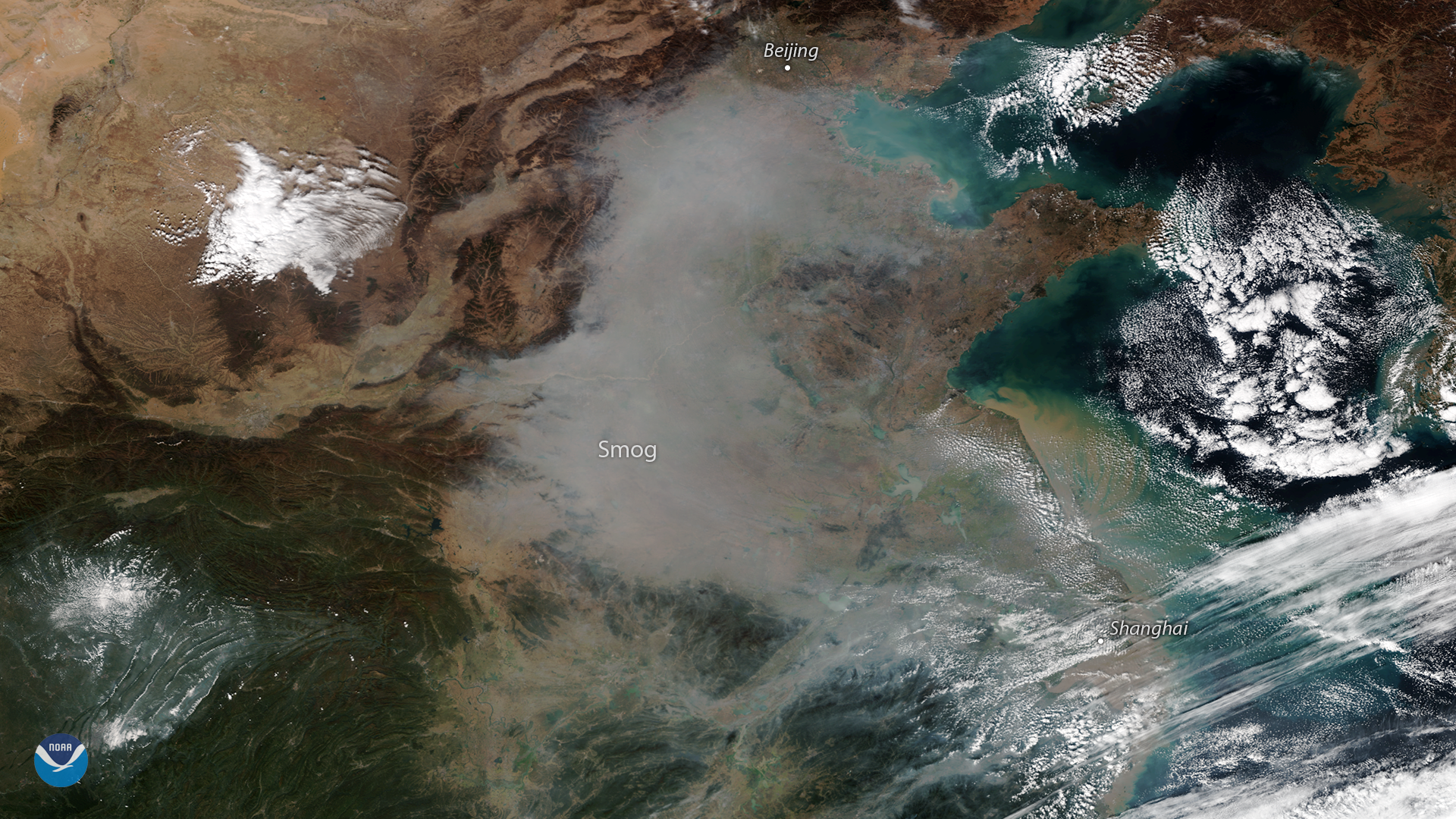
A plume of smog appears over northeastern China in this true-color image seen from the NOAA-20 satellite on October 31, 2018. While air quality in China has dramatically improved in recent years, thanks to ambitious government efforts to reduce coal consumption, pollution levels periodically still spike – especially during the fall and winter months, when more coal is burned for residential and commercial heating. In recent days, air quality in Beijing has reached unhealthy levels. On November 2, air quality reports showed widespread fine particulate concentrations (PM2.5) above 200 micrograms per cubic meter in the Chinese capital,following several days of a high pressure weather pattern that trapped pollutants near the surface. In addition to the smog, we can see several other interesting features in this satellite imagery. The outermost cloud bands of former Typhoon Yutu (now a tropical depression) appear in the lower right, while a dusting of snow is visible in the mountainous highlands along the border of China's Sichuan and Shaanxi provinces in the lower left. The NOAA-20 satellite's VIIRS instrument provides global coverage twice per day with a 750-meter resolution across its entire span. Its multi-channel imaging capabilities allow us to detect atmospheric aerosols, such as dust, smoke, and haze associated with industrial pollution.
Representative image for context; not directly related to the specific event in this article. License: Public domain. Source: Wikimedia Commons.

For U.S. readers, the development matters because East Asia’s air-quality dynamics can influence regional health advisories, travel planning, and supply chains tied to Korea’s large electronics and automotive sectors. Periodic pollution episodes can also affect manufacturing environments and logistics in the region.

Official forecasts come from the Korea Meteorological Administration and local meteorological services. They will continue to monitor air quality and weather conditions, with updates issued as conditions change.

Subscribe to Journal of Korea

Don’t miss out on the latest issues. Sign up now to get access to the library of members-only issues.
jamie@example.com
Subscribe