Samsung Chairman Returns From Europe as EV Battery Ties With Automakers Expand

Samsung Electronics Chairman Lee Jae-yong returned to Seoul on the afternoon of the 13th, arriving at the Seoul Gimpo Business Aviation Center, as he closed a Europe-focused trip aimed at assessing cooperation with major European customers.

During brief exchanges with reporters, Lee confirmed that he had met with European clients on the trip, signaling active business discussions. He did not provide additional remarks about global crisis response plans in light of ongoing conflicts around the region.

A noteworthy aspect of the journey was the participation of Choi Ju-seon, president of Samsung SDI, who accompanied Lee. The two were reported to have visited Germany and held meetings with leading European automakers.

This broad panorama of the Carina Nebula, a region of massive star formation in the southern skies, was taken in infrared light using the HAWK-I camera on ESO’s Very Large Telescope. Many previously hidden features, scattered across a spectacular celestial landscape of gas, dust and young stars, have emerged. Some of these features have been annotated in Commons. Trumpler 16 (annotated) is an open cluster that contains the luminous, massive blue variable Eta Carinae, one of the brightest stars in the galaxy, possibly as much as 120 times the mass of the Sun, and emitting the light of 4,000,000 Suns. Eta Carinae is nearing the end of its life, and is surrounded by a huge nebula, cast off by numerous eruptions of the star over the last several centuries; it is expected to explode into a supernova at any time. Trumpler 14 (annotated) contains the huge double star HD 93129 A/B. The young O3 class star HD 93129 A is one of the brightest stars in the galaxy that is still on the main sequence, and with a luminosity equivalent to 3,000,000 Suns, is very nearly as bright as Eta Carinae, but this is not obvious in the photo due to obscuring nebulosities.
Representative image for context; not directly related to the specific event in this article. License: CC BY 4.0. Source: Wikimedia Commons.

On the return flight, Choi told reporters that the team met with several clients beyond Mercedes-Benz, indicating broad engagement with European manufacturers during the trip. Observers expect that this extended engagement could lead to meaningful developments in the battery business.

Samsung SDI currently counts BMW and Volkswagen among its European customers and is said to be in discussions with Mercedes-Benz about supplying electric-vehicle batteries. The company has historically sought to deepen ties with automakers in Europe as demand for EV batteries grows.
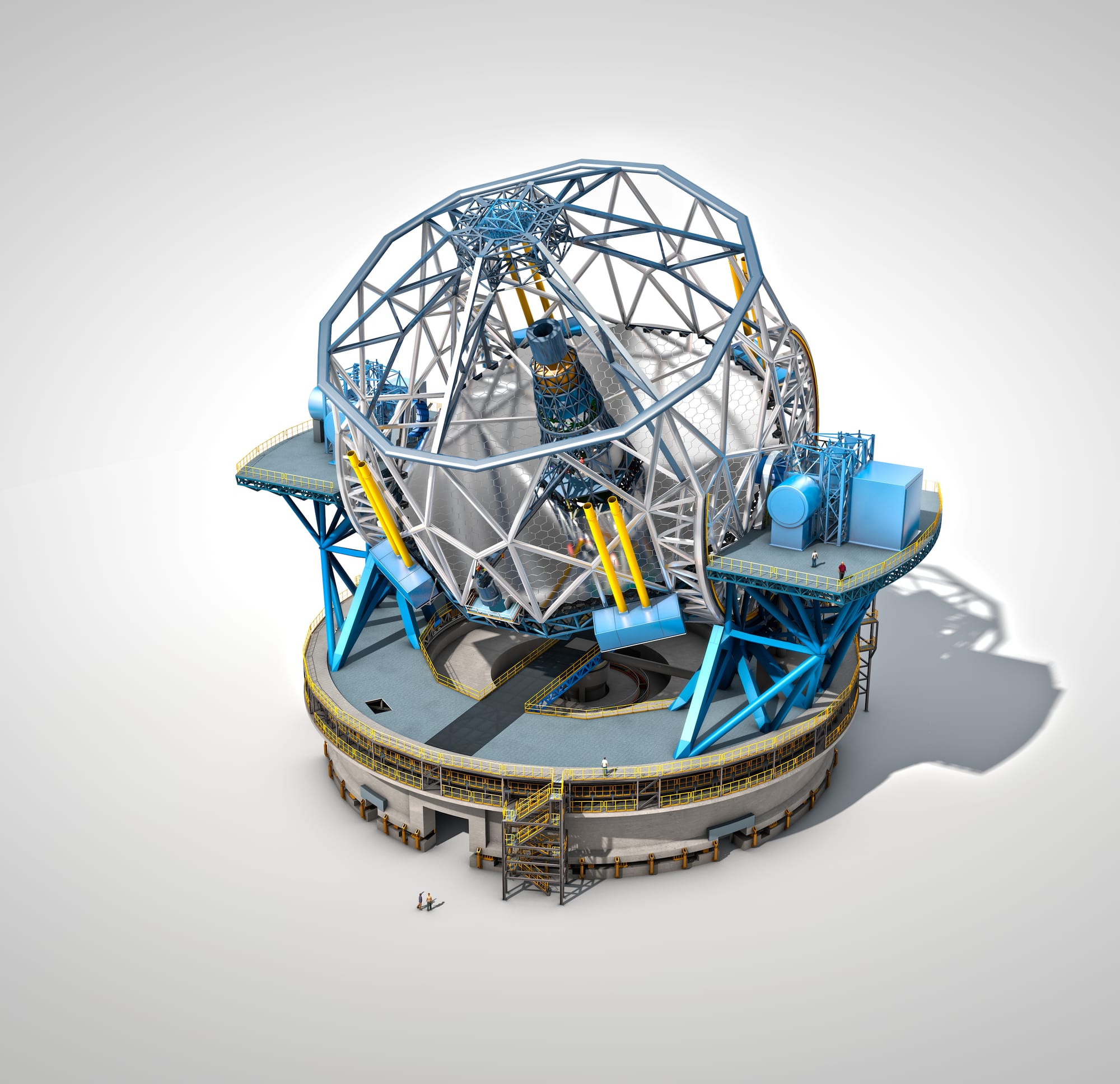
The European Extremely Large Telescope (E-ELT), with a main mirror 39 metres in diameter, will be the world’s biggest eye on the sky when it becomes operational early in the next decade.  The E-ELT will tackle the biggest scientific challenges of our time, and aim for a number of notable firsts, including tracking down Earth-like planets around other stars in the “habitable zones” where life could exist — one of the Holy Grails of modern observational astronomy. 
The telescope design itself is revolutionary and is based on a novel five-mirror scheme that results in exceptional image quality. The primary mirror consists of almost 800 segments, each 1.4 metres wide, but only 50 mm thick.  The optical design calls for an immense secondary mirror 4.2 metres in diameter, bigger than the primary mirrors of any of ESO's telescopes at La Silla.
Adaptive mirrors are incorporated into the optics of the telescope to compensate for the fuzziness in the stellar images introduced by atmospheric turbulence. One of these mirrors is supported by more than 6000 actuators that can distort its shape a thousand times per second.
The telescope will have several science instruments. It will be possible to switch from one instrument to another within minutes. The telescope and dome will also be able to change positions on the sky and start a new observation in a very short time.

The very detailed design for the E-ELT shown here is preliminary.
Representative image for context; not directly related to the specific event in this article. License: CC BY 4.0. Source: Wikimedia Commons.

Lee has previously strengthened connections to the auto sector, including discussions on broader EV cooperation with Mercedes-Benz chairman Ola Kalenius during his visit to Korea in November last year. Those talks illustrate a continuing push to align Samsung SDI’s battery capabilities with major European brands.

For U.S. readers, the trip underscores how South Korea’s battery manufacturers are intensifying relations with European automakers, a development with potential implications for global EV supply chains, competitive dynamics in battery technology, and the reach of Korean suppliers into key markets. The outcomes could influence pricing, production planning, and partnership strategies that affect both European and American automakers and their suppliers.

The Seoul Gimpo Business Aviation Center, or SGBAC, serves private and corporate flights near Gimpo Airport in western Seoul, providing a rapid link for executives traveling between Korea and Europe.

Subscribe to Journal of Korea

Don’t miss out on the latest issues. Sign up now to get access to the library of members-only issues.
jamie@example.com
Subscribe