Guterres Visits Beirut, Urges Immediate Ceasefire and Expanded Aid in Israel-Hezbollah Conflict

UN Secretary-General Antonio Guterres visited Beirut on the 13th amid fighting between Israel and Hezbollah, the Iran-backed Lebanese militant group, and urged an immediate ceasefire and expanded humanitarian aid.

In Beirut, Guterres appealed for emergency relief, calling for a total of about 308.3 million U.S. dollars in humanitarian assistance for Lebanon, roughly 460 billion won, to help civilians affected by the violence.
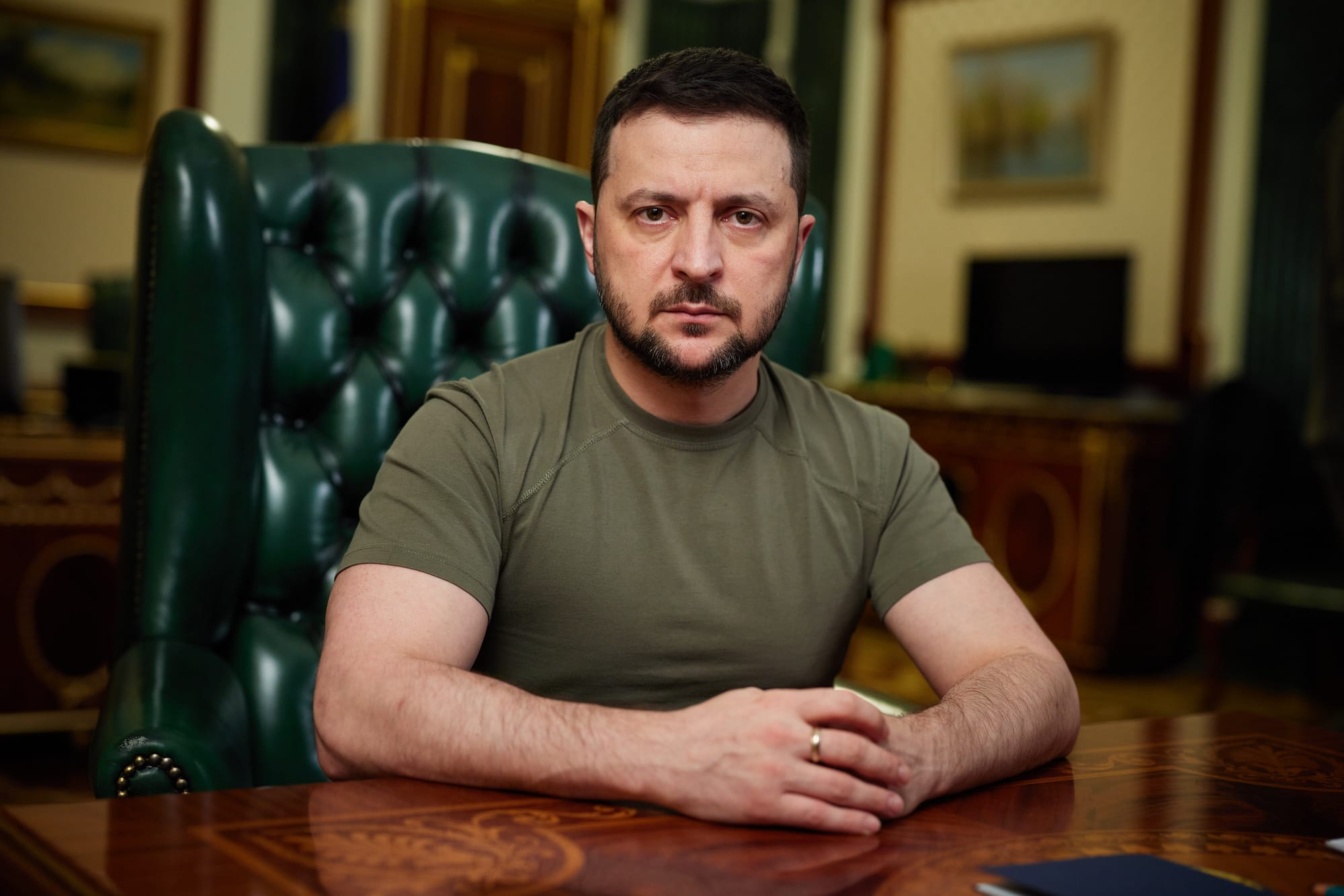
Ukrainians!
All our defenders!
Today we have significant news for our state, for our defense.
First, the United States has prepared a new support package for Ukraine worth $ 33 billion. In particular, more than 20 billion can be allocated for defense. More than $ 8 billion is planned for economic support. Another $ 3 billion will be allocated for humanitarian aid.
This is a very important step by the United States. And I am grateful to the American people and personally to President Biden for it. I hope that the Congress will quickly support this request for help to our state. President Biden rightly said today that this step is not cheap. But the negative consequences of Russia's aggression against Ukraine and against democracy are so large-scale for the whole world that, in comparison with them, this support from the United States is necessary. Together, we can certainly stop Russian aggression and reliably defend freedom in Europe.
We are also working to direct the blocked assets of Russian individuals subject to sanctions and the Russian state to compensate Ukraine for this war and to restore normal life.
The investigation into the crimes committed by the Russian military against our people is underway. Ukraine's position is absolutely clear - every Russian criminal must be and will be brought to justice. Whoever they are and wherever they hide, we will find them all and make them bear responsibility.
The first ten Russian servicemen from the 64th motorized rifle brigade of the Russian Ground Forces who committed crimes against our people in Bucha, Kyiv region, received the status of suspects. Their surnames are known. It is established what they did. We know all the details about them and their actions. And we will find everyone. Just as we will find all the other Russian thugs who killed and tortured Ukrainians. Who tormented our people. Who destroyed houses and civilian infrastructure in Ukraine. None of these bastards will avoid responsibility.
However, some of them may not survive until trial and fair punishment. But for one reason only. This Russian brigade was relocated to the Kharkiv region. There they will get retribution from our military.
Prime Minister of Bulgaria Kiril Petkov paid a visit to Kyiv today. We had very substantive and very warm negotiations with him. Bulgaria is one of those countries that reacted to Russia's aggression in a principled manner and quickly. I am grateful to both the Bulgarian government and the Bulgarian people for not delaying the support for our state.
Defense, energy and transport issues were discussed with Mr. Petkov. Sanctions pressure on Russia, which is necessary for peace. We also discussed our cooperation at the EU level. A very important agreement is on the repair of our military equipment at the Bulgarian production facilities.
Another issue we agreed on is the supply of Ukrainian electricity to Bulgaria and the use of the Trans-Balkan gas pipeline together with the Bulgarian side. I am grateful to Bulgaria for the opportunity to use the port of Varna to export our agricultural capacity.
UN Secretary-General António Guterres was also in Ukraine today. It is very important that Mr. Secretary-General visited Borodyanka, Kyiv region. And saw with his own eyes what the Russian occupiers had done there. Hundreds of Ukrainian cities and hundreds of communities have experienced the same thing as Borodyanka and Bucha. The Russian army in Ukraine consciously and without any doubt trampled down everything on which the global order was based after World War II.
The UN Charter, international conventions, declarations, the rights of people and states... Everything that should guarantee freedom and security in the world is simply destroyed by Russia's aggressive actions. So the key issue in the talks with the UN Secretary-General was how to stop Russian aggression. And this is not just a question of Ukraine, our fate. This is a question of the fate of the United Nations, the fate of international law, the fate of many nations - and not just Russia's neighbors who may become the next victims of Moscow's aggressive ambitions.
Of course, during the negotiations we paid a lot of attention to saving our people from Mariupol. I believe that with the help of the UN it is possible to organize an evacuation mission. Ukraine is ready for these steps. But it is also necessary for the Russian side to consider this issue without cynicism and actually do what it says.
Moscow claimed they had allegedly ceased fire in Mariupol. But the bombing of the defenders of the city continues. This is a war crime committed by the Russian military literally in front of the whole world. Russia's shelling of Mariupol did not stop even when the UN Secretary-General was holding negotiations in Moscow.
And today, immediately after the end of our talks in Kyiv, Russian missiles flew into the city. Five missiles.
And this says a lot about Russia's true attitude to global institutions. About the efforts of the Russian leadership to humiliate the UN and everything that the Organization represents. Therefore, it requires a strong response.
Russian missile strikes at Ukraine - Kyiv, Fastiv, Odesa, and other cities - once again prove that we cannot let our guard down. We cannot think that the war is over. We still have to fight. We still have to drive the occupiers out.
Today, the Russian army continued its offensive attempts in the east of our country, in Donbas. Tries to advance in the southern regions.
The Armed Forces of Ukraine repel the invaders. And I am grateful to each of our defenders who are holding positions.
We are doing everything to help our army, to provide the military with all the necessary weapons.
Every time I contact my partners, I emphasize that weapons for Ukraine right now, the very types we ask for and just when we need them, are salvation not only for our people. This is salvation for all of you - for all of Europe.
I am grateful to those partners who understand this. And who help convince others.
Before delivering the evening address, I signed a decree awarding our heroes. 214 servicemen of the Armed Forces of Ukraine were awarded state awards. 14 of them posthumously.
Eternal memory to all who gave life for Ukraine!
Eternal glory to all who stood up for the state!

Glory to Ukraine!
Representative image for context; not directly related to the specific event in this article. License: CC0. Source: Wikimedia Commons.

Lebanon has seen more than 810,000 people displaced since the start of the cross-border hostilities between Israel and Hezbollah, according to United Nations agencies.

Hezbollah, which receives backing from Iran, has carried out retaliatory attacks against Israel, further drawing Lebanon into the broader regional conflict.

Israel has conducted airstrikes across southern Lebanon and near the Lebanese capital, Beirut, with authorities advising residents in several areas to evacuate.

Anne Richard, U.S. Assistant Secretary of State for Population, Refugees, and Migration, participates in a Google+ Hangout with Antonio Guterres, UN High Commissioner for Refugees, and Lara Setrakian, Founder of Syria Deeply, on assistance to Syria on March 19, 2013. [State Department photo/ Public Domain]
Representative image for context; not directly related to the specific event in this article. License: Public domain. Source: Wikimedia Commons.

Guterres, who met with Lebanon’s president, stressed that the message is clear: there must be an end to the fighting and an immediate move toward a durable ceasefire, with unhindered humanitarian access.

For the United States, the flare-up matters beyond Lebanon because it risks regional instability, potential disruptions to energy shipments through the Eastern Mediterranean, and broader implications for U.S. diplomacy, defense partnerships, and humanitarian commitments in a volatile Middle East. The situation also tests how international aid and sanctions policies interact with conflict dynamics in a key allied theater.

Subscribe to Journal of Korea

Don’t miss out on the latest issues. Sign up now to get access to the library of members-only issues.
jamie@example.com
Subscribe