South Korea Enforces Temporary Fuel-Price Cap, Early Effects Leave Pumps Largely Unchanged

South Korea began enforcing a temporary maximum price system for petroleum products on March 13, 2026. In Jeonju, the capital of Jeollabuk-do, a gas station in Deokjin District posted gasoline at 1,755 won per liter and diesel at 1,779 won per liter at around noon, with the lines of vehicles still long. The station operates as a self-serve outlet, but staff were directing the queue due to demand.

The government has set initial maximum prices for wholesale supply: 1,724 won per liter for gasoline and 1,713 won per liter for diesel. However, officials emphasize that these figures apply to refiners’ supply prices, not directly to what consumers pay at the pump, and the policy’s retail impact may vary as stations adjust.
6 
PETER HENDERSON & CO., NEW YORK. — WHOLESALE CATALOGUE. — PLANTS. 
A NEW RACE OF.... 
Hardy 
Running 
Roses 
Hybrids of Rosa Wichuraiana. 
(The Memorial Rose.) 
AMONG the many new forms of 
Roses introduced of late, and 
the present decade has been 
most prolific in new classes, we 
believe that none will outrival ^ 
these in general usefulness. We ( 
had the pleasure of first call- 
ing wide public attention 
to the merit of one of the 
parents of these Roses. / e., 
the Memorial Rose" (Rosa 
Wichuraiana), and so it is 
with added pleasure that we 
announce the advent of these 
new Roses. They retain the 
prostrate habit of the Wichu- 
raiana, with its distinctive 
charm of foliage and its 
vigor of growth ; in fact, 
they are, if anything, 
stronger than the parent. 
We saw them growing on a 
gravelly terrace where it 
would seem no Rose would 
find sufficient sustenance to 
grow, and yet they made 
from 15 to 18 feet of growth 
in one season. We predict 
unbounded popularity for 
these, whether for use in 
the private garden, in the 
cemetery, or in large public 
parks, for covering rocky 
slopes, embankments, etc. 
The double varieties will 
unquestionably make grand 
pot plants for the green- 
house or conservatory, and 
can also be used as climbers, 
and we believe that the 
white variety will eventually 
take rank with the Crimson 
Rambler and form a splen- 
did contrast to it. 
THE DOUBLE 
WHITE "MEMORIAL 
ROSE." (No. 3 in cut.) 
(Manda's Triumph ) 
This is the gem of the collection, 
and may well be called the Double 
" Memorial Rose" as it preserves 
the color of the parent, with its 
characteristics of growth and foli 
age, but the flowers are double and very 
fragrant. They are produced in clusters 
of from twelve to eighteen flowers on 
each cluster on small side shoots, liter- 
ally covering the plant and standing well 
above the foliage, giving a very graceful 
appearance. This variety will be valua- 
ble for all purposes, whether for trailing on the ground 
for cemetery use, growing on fences and gate posts, 
boundary walls, or as specimens in pots or tubs. 
For prices see end of list — next column. 
SOUTH ORANGE 
PERFECTION. (No. 4 in cut.) 
This variety is similar to the preced- 
ing in growth. It has double flowers, 
soft blush changing to white, about 
one and one-half inches in diameter. 
The blossoms are, if anything, more 
freely produced than on the preced- 
ing, and are more double, perfect 
rosettes in shape. This is a very 
pretty variety and entirely distinct 
from the others. 
This variety shows undoubted 
traces of descent from the Sweet 
Brier, both in the color and the shape 
of the blossom and in its exquisite 
fragrance. The single flowers are 
over two inches in diameter, a bright 
rich pink, with a large, silvery-white 
centre and orange red stamens, pro- 
ducing a most charming effect. 
Price for any of the new Roses 
on this page, 2 year old plants 
from 5 and 6 Inch pots, 40c. each , 
$4.00 per doz. Plants from 3 inch 
pots, $1.50 doz., $10.00 per 100. 

COPY* OtlT 1898 BY PETER HENDERSON & CO
Representative image for context; not directly related to the specific event in this article. License: Public domain. Source: Wikimedia Commons.

Even so, observers say the effect has not yet been dramatic. Lee Gi-ju, in his 60s, told News1 that while the government says prices are down, pumps in his area still show prices in the 1,700s to 1,800 won range, and relief has not been strongly felt. Park, in his 50s, likewise said it remains unclear how much the cap will curb prices in the near term.

On the same day in WanSan District, another station set gasoline at 1,790 won per liter and diesel at 1,770 won, higher than prices on March 10 (1,750 won for gasoline and 1,725 won for diesel). Station operators say they cannot lower prices immediately because much of their current stock was purchased before the price cap took effect, and they must work through those inventories.

A station official explained that most of the fuel on sale was procured before the policy began, so some outlets may temporarily see price increases until that stock is depleted. He added that while prices are being trimmed where possible, it is not feasible to slash prices drastically while lingering red ink from pre-purchased fuel remains.
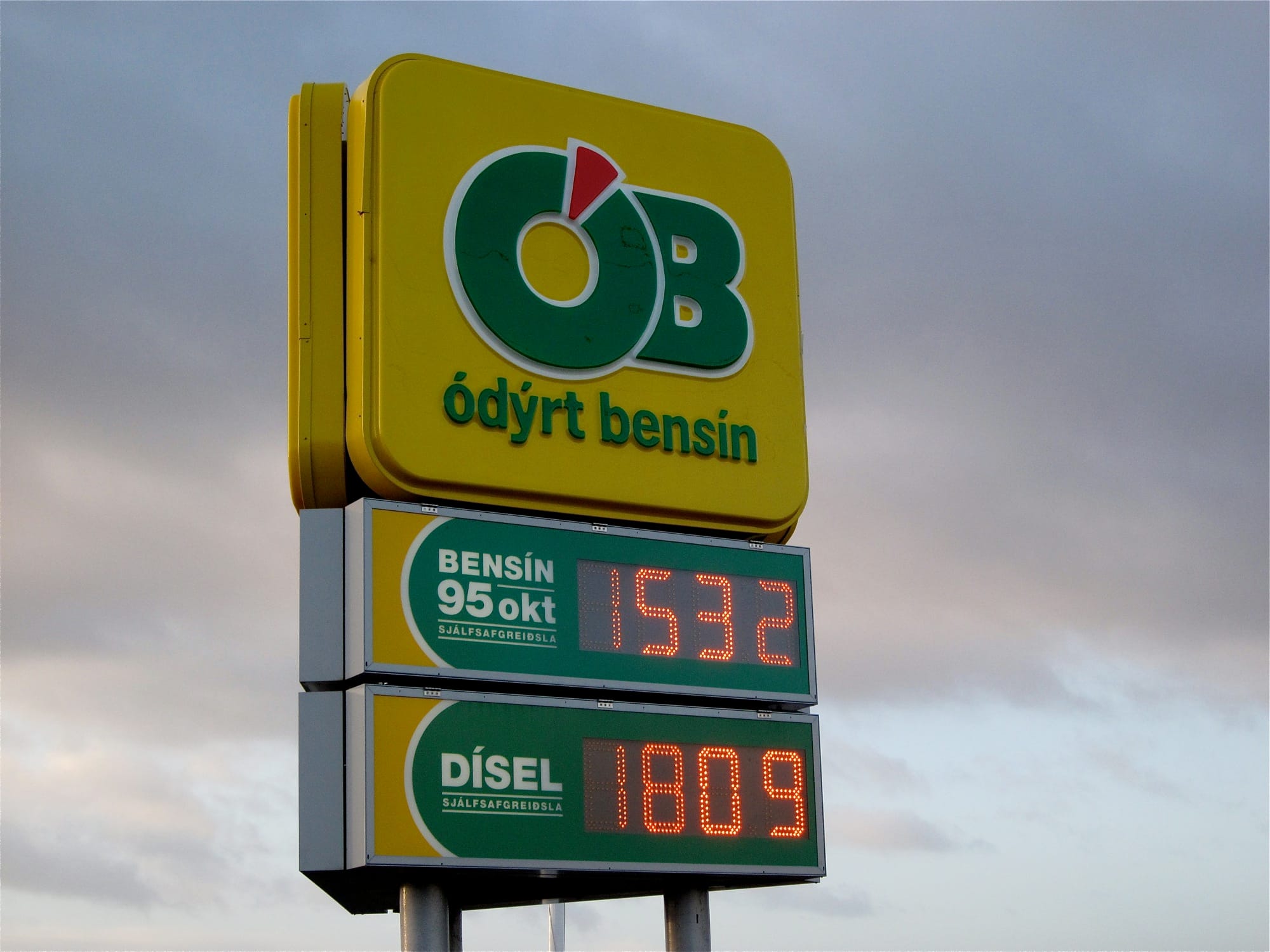
Those are in kronur per liter- let's see who can do the math...
Representative image for context; not directly related to the specific event in this article. License: CC0. Source: Wikimedia Commons.

Regional data show a slight downward trend in average prices. According to OPINET, Korea National Oil Corp.’s price-information service, Jeollabuk-do’s average gasoline price was 1,897 won per liter, down from 1,904 won on March 10, with diesel averaging 1,907 won, down from 1,913 won. The competition among outlets is shifting as well: previously, the top 10 cheapest stations in Jeonju were all company-operated; on the latest tally, four of the top 10 were Altteul (budget) stations.

Why this matters beyond Korea: South Korea is a major energy consumer and a key ally in the Asia-Pacific security and supply-chain ecosystem. How Seoul handles fuel-price volatility can influence regional energy costs, inflation, and the reliability of supply chains that affect global manufacturers, including U.S. automakers and tech firms. The experience with price caps and stock-rotation dynamics provides real-world insight into how government interventions interact with market behavior, an issue of relevance to policy discussions in the United States about energy security, inflation management, and price stability.

Subscribe to Journal of Korea

Don’t miss out on the latest issues. Sign up now to get access to the library of members-only issues.
jamie@example.com
Subscribe