South Korea mobilized wildfire response as U.S. helicopters assisted

A major wildfire in March last year in South Korea’s Gyeongsangnam-do began in Sicheon-myeon, Sancheong, and spread to the boundary areas of Jayang-ri in Dansong-myeon and Douyang-ri in Okjong-myeon, Hadong. It burned for about 213 hours, making it one of the longest-lasting fires on record, and scorched 1,858 hectares, roughly equivalent to 2,600 football fields.

Initially, firefighting was directed by the Sancheong-gun mayor, but as the blaze exceeded 100 hectares the command shifted to the Gyeongnam provincial governor, and when the area surpassed 1,000 hectares the Korea Forest Service chief took integrated command. The U.S. military’s CH-47 Chinook helicopters were deployed to assist in the efforts.

The fire claimed four lives among firefighting crews and public officials, with 10 people seriously injured and 2,158 residents displaced. In a separate incident in Chungnam’s Hongseong in April 2023, another wildfire burned 1,337 hectares, about 2,036 football fields, illustrating the scale of such events in the region.
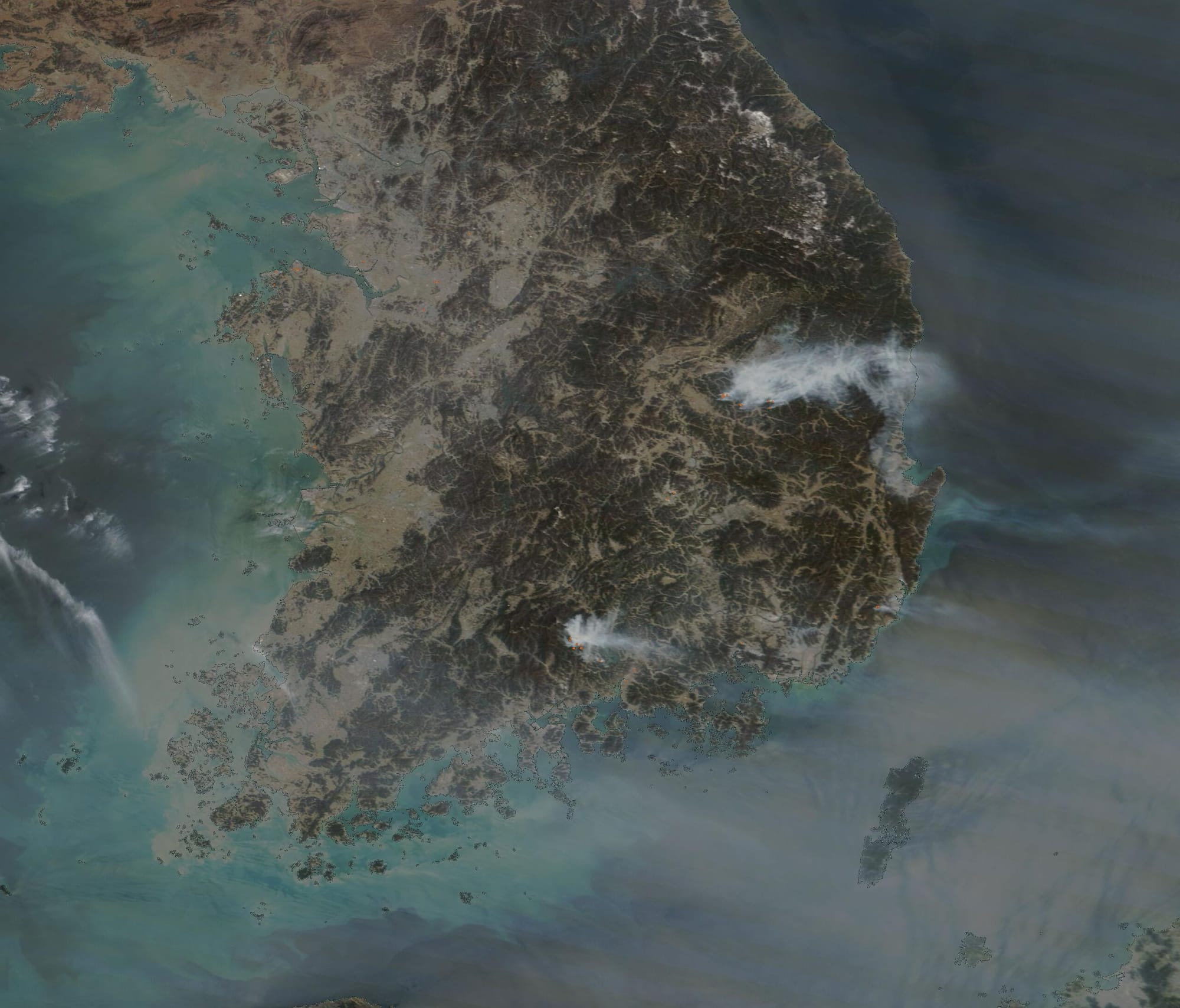
Dozens of wildland fires broke out as dry winds swept across South Korea in March 2025. Blazes began igniting on March 21, prompting evacuations as well as the deployment of thousands of personnel and more than 100 helicopters to combat the fires, according to news reports.
Smoke from some of the larger fires is visible in this true-color image, acquired by the Moderate Resolution Imaging Spectroradiometer (MODIS) on NASA’s Terra satellite on March 23. One of the plumes billowed from an area burning near Andong in Uiseong County. More than 1,000 people evacuated the area, several sections of highway and a rail line were forced to close, and an ancient temple was destroyed by the flames. Red “hot spots”, combined with typical gray smoke, mark actively burning fires.
To the south, another large smoke plume originated from rural Sancheong County. A large, fast-moving fire had burned over 500 hectares (2 square miles) by the evening of March 22, the Associated Press reported, and caused multiple injuries and deaths. Mountainous terrain and strong winds made containment efforts challenging. Officials issued strong wind advisories for several counties on March 21 and 22 and discouraged people from burning trash and agricultural products. Dry weather also contributed to the fire risk. March through May is the driest time of year in the region.

As of March 24, many of the fires had been extinguished, according to officials cited in news reports, and the large blazes in Uiseong and Sancheong counties were each about two-thirds contained. In total, the fires were reported to have burned at least 8,700 hectares (34 square miles). The government declared a state of disaster for several of the affected regions.
Representative image for context; not directly related to the specific event in this article. License: Public domain. Source: Wikimedia Commons.

The two fires share a common timing, erupting in March and April. The Korea Forest Service notes that in the past decade, 46% of all wildfires and 96% of the damage have occurred in March and April. Large fires (over 100 hectares) also cluster in these months, with 28 of 38 such events occurring in March or April.

In response, the government convened a wildfire countermeasures meeting involving 16 ministries and agencies on March 13 and declared April 14–19 a “Large Wildfire Special Countermeasure Period.” Under the integrated plan drafted after last year’s ultra-large fires in the Yeongnam region, authorities pledged rapid helicopter dispatch within 30 minutes, expanded military helicopter support (up to 143 aircraft), and reinforced personnel and equipment to mobilize national resources as needed.
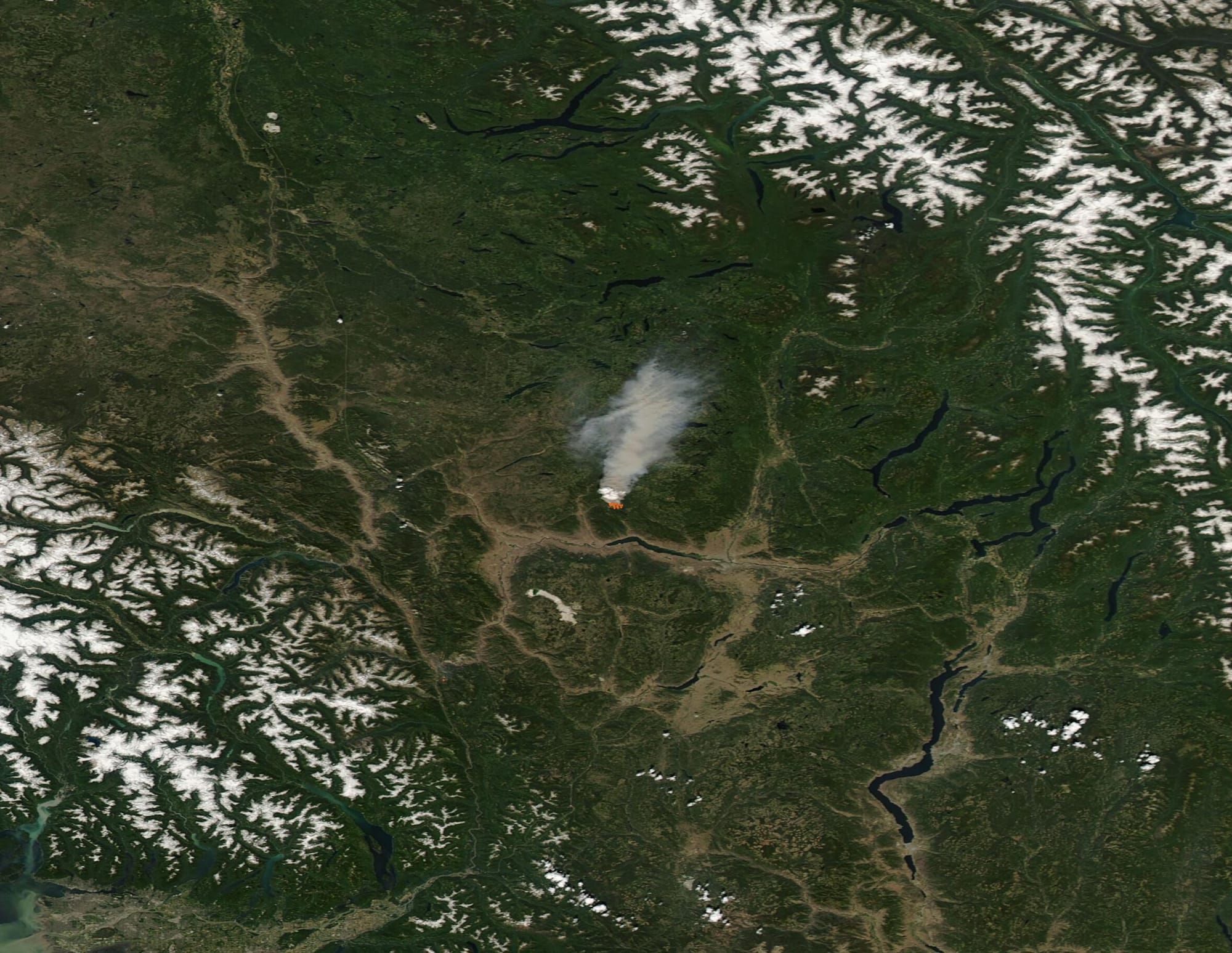
Extreme heat and high wind contributed to an early and angry start to the summer fire season in British Columbia, Canada. According to the B.C. Wildfire Dashboard, there have been 416 wildfires in the province since January 1, 2021, with 51 of those reported during the last week. On June 30, there were 41 active wildfires burning in British Columbia, which is an increase of 26 fires in the last two days alone.
Record-breaking heat has gripped Western Canada and the Western United States over the last several days, driving dangerous fire conditions. The British Columbia Wildfire Service’s Daily Danger Rating on June 30 showed at least three-quarters of the province at Extreme or High Fire Danger.
All-time high temperature records have been broken repeatedly across British Columbia since June 25. The village of Lytton, which sits north of Vancouver at the confluence of the Fraser and the Thompson Rivers, broke record high daily and all-time temperatures for all of Canada—three days in a row. The previous record of 45˚C (113˚F) was set in Saskatchewan in 1937. On June 27, Lytton edged ahead with 46.1˚C (115˚F) and the next day the temperature reached 47.9˚C (118.2˚F). The record was shattered once again as temperatures hit 49.5˚C (121˚F) on June 29. On the heels of the extreme heat, a fire sparked in Lytton, a town of about 250 people, causing an evacuation order for the entire town. Social media posts claim that the fire erupted so fast that people only had time to get to their cars and leave, and that several buildings have been engulfed.
On June 29, the Moderate Resolution Imaging Spectroradiometer (MODIS) on board NASA’s Aqua satellite acquired a true-color image of another fire burning in British Columbia. This is the Sparks Lake Fire, which sparked to life on June 28 just 15 miles north of Kamloops Lake. With extreme fire behavior, the fire quickly exploded to affect about 4,000 hectares (9,884 acres) by June 30. The Sparks Lake Fire is currently listed as “out of control”.

High temperatures and gusting winds not only aid fire ignition and growth across British Columbia but have also made firefighting difficult. A tweet by the BC Wildfire Service on June 30 read, “The hot weather continues to cause challenges. Multiple helicopters had to shut down due to engines overheating. Suppression efforts were impacted due to the helicopters restricted lifting capacity in heat, limiting the amount of water they can put in their buckets at a time.”
Representative image for context; not directly related to the specific event in this article. License: Public domain. Source: Wikimedia Commons.

During the special period, the government will boost preventive patrols and enforcement, including weekend crackdowns on illegal burning. About 1,300 forest-fire special investigative police officers will be mobilized, and if arson or a major wildfire occurs, a dedicated arson investigation team will pursue perpetrators to the end and pursue civil and criminal accountability.

Officials emphasize that, if a large wildfire threatens a region, the Korea Forest Service chief will directly command on-site, and local disaster and integrated command centers will be activated to ensure rapid response. Park Eun-sik, the head of the Korea Forest Service, warned that unprecedented weather patterns have driven multi-site, large-scale fires and that resources alone may be insufficient, necessitating swift coordination among central authorities, local governments, and public agencies to protect lives and property.

For U.S. readers, the developments matter because South Korea is a key ally with U.S. forces stationed on the peninsula. The firefighting collaboration, including U.S. helicopters, highlights interoperability and the potential for joint emergency response. Wildfire risk in the region can disrupt supply chains, transportation networks, and regional stability, underscoring why climate-driven disasters in a major alliance partner attract attention from policymakers and markets in the United States.

Subscribe to Journal of Korea

Don’t miss out on the latest issues. Sign up now to get access to the library of members-only issues.
jamie@example.com
Subscribe