Former Seoul police chief to face criminal complaint over Itaewon oath refusal

At a hearing in Seoul on the 12th, the Special Investigation Committee for Truth-Finding and Recurrence Prevention of the Itaewon disaster announced it would file a criminal complaint against Kim Gwang-ho, the former head of the Seoul Metropolitan Police Agency, for refusing to take an oath as a witness.

The session was held at the Banking Hall in Jung-gu, Seoul, in the International Conference Room on the building’s second floor, as part of the ongoing inquiry into the Itaewon tragedy.

Special committee member Song Gi-chun said during the afternoon session that the committee would pursue a prosecution action over Kim’s refusal to swear an oath.
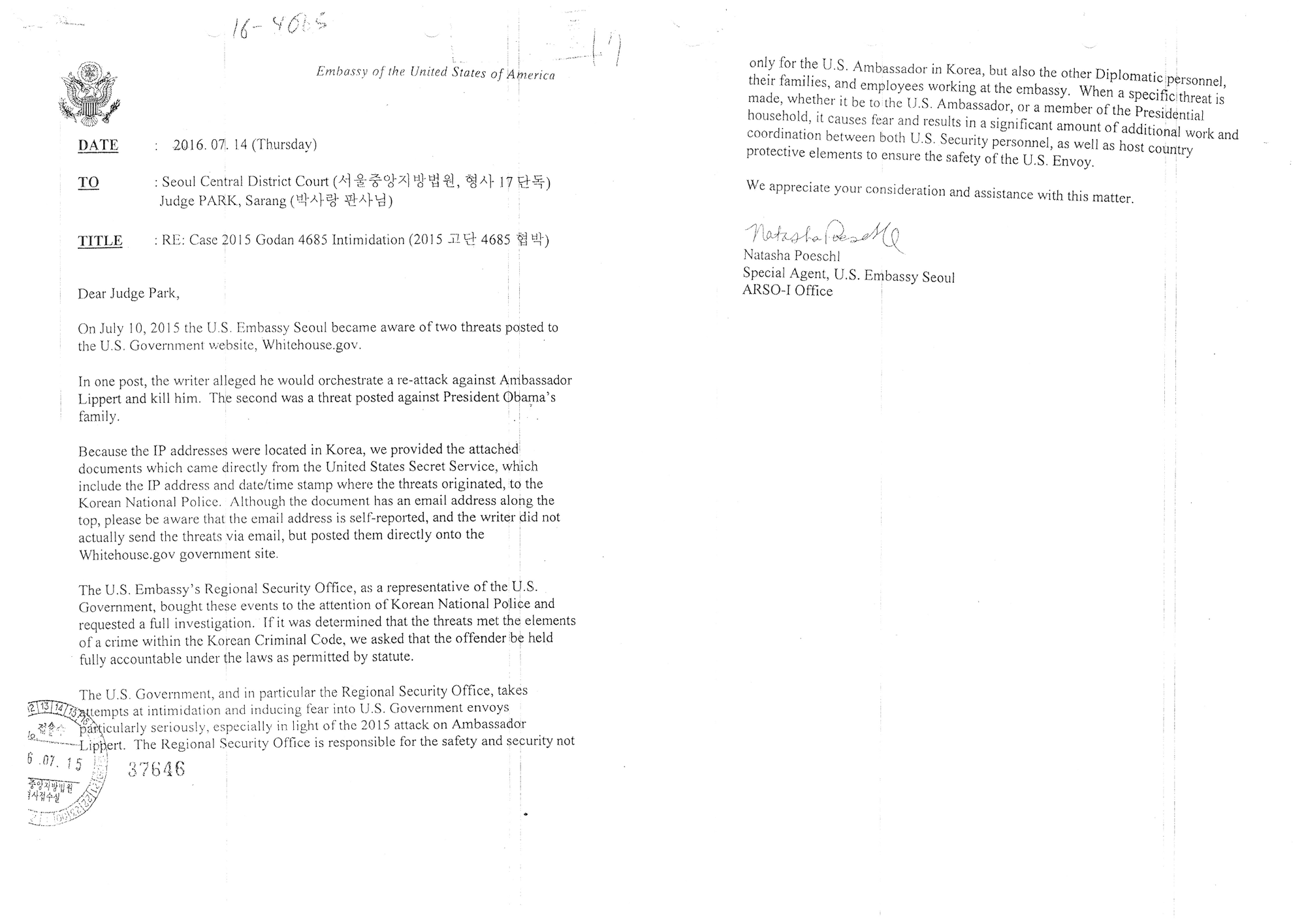
"DATE : 2016. 07.( 14 (Thursday)
TO : Seoul Central District Court (서울중앙지방법원 형사 17 단독)
Judge PARK, Sarang (박사랑 판사님)
TITUE : RE: Case 2015 Godan 4685 Intimidation (2015 고단 4685 협박)
Dear Judge Park,
On July 10, 2015 the Embassy Seoul became aware of two threats posted to
the U.S. Government website, Whitehouse.gov.
In one post, the writer alleged he would orchestrate a re-attack against Ambassador
Lippert and kill him. The second was a threat posted against President Obama’s
family.
Because the IP addresses were located in Korea, we provided the attached
documents which came directly ft■이n the United States Secret Service, which
top, please be aware that the email address is self-reported, and the writer did not
actually send the threats via email, but posted them directly onto the
Whitehouse.gov government site.
include the IP address and date/time stamp where the threats originated, to the
Korean National Police. Although the document has an email address along tl
The U.S. Embassy’s Regional Security Office, as a representative of the U.S.
Government, bought these events to the attention of Korean National Police and
requested a ftill investigation. If ii was determined that the threats met the elements
of a crime within the Korean Criminal Code, we asked that the offender be held
fiilly accountable under the laws as permitted by statute.
The U.S. Government, and in particular the Regional Security Office, takes
at intimidation and inducing fear into U.S. Government envoys
p^Vcularly seriously, especially in light of the 2015 attack on Ambassador
> ’¨Lippert. The Regional Security Office is responsible for the safety and security not
쓿 37G46

sz靜, ’"
Representative image for context; not directly related to the specific event in this article. License: CC BY-SA 4.0. Source: Wikimedia Commons.

Earlier in the day, Kim submitted a written notice exercising his right to refuse to testify and then declined to provide testimony at the hearing. The committee documented his oath-refusal as the reason for his decision.

Kim’s stance, according to reports, cited that he is facing criminal proceedings over alleged inadequate responses to the Itaewon incident, which he said justified his decision not to testify.
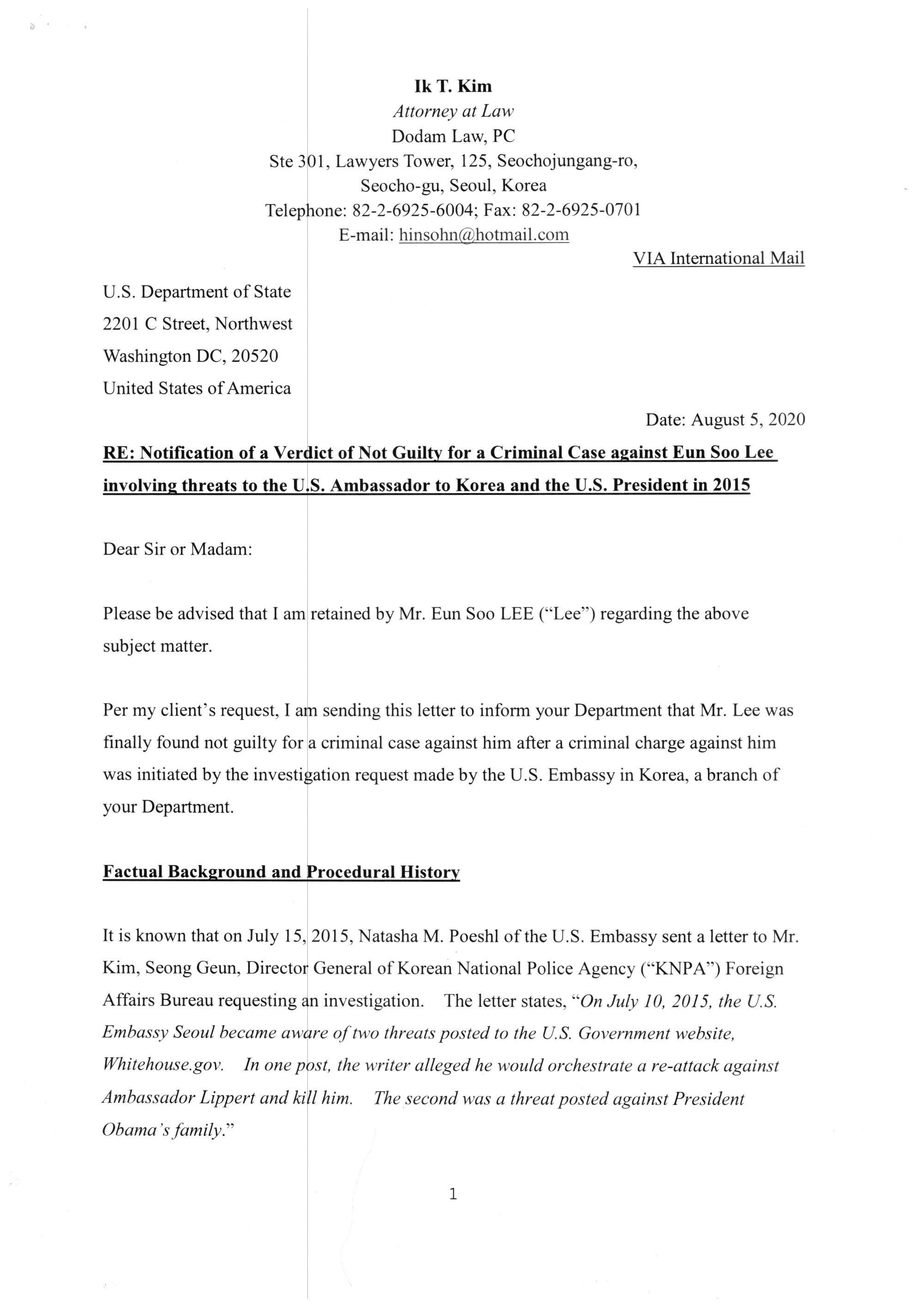
"Ik T. Kim
Attorney at Law
Dodam Law, PC
Ste 301, Lawyers Tower, 125, Seochojungang-ro,
Seocho-gu, Seoul, Korea
Telephone: 82-2-6925-6004; Fax: 82-2-6925-0701
E-mail: hinsohn@hotmail.com
VIA International Mail
U.S. Department of State
2201 C Street, Northwest
Washington DC, 20520
United States of America
Date: August 5, 2020
RE: Notification of a Verdict of Not Guilty for a Criminal Case against Eun Soo Lee involving threats to the U.S. Ambassador to Korea and the U.S. President in 2015
Dear Sir or Madam:
Please be advised that I am retained by Mr. Eun Soo LEE (“Lee”) regarding the above subject matter.
Per my client’s request, I am sending this letter to inform your Department that Mr. Lee was finally found not guilty for a criminal case against him after a criminal charge against him was initiated by the investigation request made by the U.S. Embassy in Korea, a branch of your Department.
Factual Background and Procedural History
It is known that on July 15, 2015, Natasha M. Poeshl of the U.S. Embassy sent a letter to Mr. Kim, Seong Geun, Director General of Korean National Police Agency (“KNPA”) Foreign Affairs Bureau requesting an investigation. The letter states, “On July 10, 2015, the U.S. Embassy Seoul became aware of two threats posted to the U.S. Government website, Whitehouse.gov. In one post, the writer alleged he would orchestrate a re-attack against Ambassador Lippert and kill him. The second was a threat posted against President Obama’s family.”
Although the letter was sent to KNPA on July 15, 2015, strangely, the Korean police acted on July 13, 2015, two days before the date of the letter sent, and arrested Mr. Lee with his computer seized. Subsequently, Mr. Lee was charged with a crime of threat and tried in a trial court. Later, the trial court rendered a judgment of guilty of the crime of “conspiracy for threat” based on the reasoning that the criminal act has not occurred because there is not enough evidence to support the allegation that the threatening posting has reached the alleged victims.
During the trial, on July 14, 2016, the Special Agent, Natasha Poeshl at the U.S. Embassy Seoul sent a letter to the court in which the Agent acknowledged that she requested an investigation on the threat to the U.S. government which was allegedly originated from an IP located in Korea. In the letter, the Agent wrote, “because the IP addresses were located in Korea, we provided the attached documents which came directly from the United States Secret Service, which include the IP address and date/time stamp where the threats originated, to the Korean National Police. Although the document has an email address along the top, please be aware that the email address is self-reported, and the writer did not actually send the threats via email, but posted them directly onto the Whitehouse.gov government site.”
The trial court's decision was overturned by the appellate court based on the finding of the due process violation in which some evidence was illegally obtained and the police did not timely return the seized computer. The appellate court, despite all the favorable evidence for the defendant, however, has not rendered an opinion on whether or not the defendant posted the threatening messages at the White House website especially when the defendant denied and negated the allegation against him.
Finally, the case went to the Supreme Court of Korea, which dismissed the appeal and upheld the appellate court’s decision of not guilty for the violation of due process. (Please see the enclosed copy of “the Korean Supreme Court's Decision”).
Upon the final decision of the Supreme Court of Korea, most of the Korean newspapers released news titled “South Korean man acquitted by the Supreme Court over cyber threat against Obama.” (Please see the enclosed copy of “the Newspaper Article by News1”).*
__________

Many of Korean newspapers and media followed up this incident and released the news that Mr. Lee was finally found not guilty after five (5) years of legal proceedings. In this regard, we also contacted other foreign news media, which covered Mr. Lee’s case in 2015 and made requests for follow up news releases.
Suspicious Investigation by the Korean Police
Mr. Lee believes that the Korean police is aware that the seized computer does not show any evidence against Mr. Lee. Yet the Korean police do not admit the absence of such evidence. Further, the Korean police investigation had strangely started even before the request for an investigation from the U.S. Embassy in Seoul was made.
Mr. Lee sends this letter of notification because the Korean court's decision was based on the procedural issue, not on merits. Thereafter, it leaves a certain amount of suspicion or a gray area regarding his complete innocence. Further, given the strange investigation of the Korean police, up to the point of due process violation, Mr. Lee suspects that the Korean police’s investigation is not reliable due to the lack of transparency as well as the inability to catch the real offender who posed a threat to the U.S. government.
As mentioned earlier in this letter, the Korean police acted before the U.S. Embassy Agent's request for investigation and claimed that it has already detected the suspect's IP address. However, the seized computer of Mr. Lee showed no evidence matching the suspect's IP address and no record of log in the Whitehouse homepage. Strangely enough, the first letter sent to the Korean police by the Special Agent Natasha Poeshl on July 15, 2015, does not mention the alleged IP address for the threat post. However, it appears in the Korean police document which was introduced into evidence during the trial.
During the trial at the trial court (the first tier court), the prosecutor sent a letter of request for confirmation to the U.S. Embassy in Korea on April 25, 2016. In the letter, the prosecutor requested the U.S. Embassy in Korea to confirm several facts including: 1) date of the threats posted; 2) the manner of the posting; 2) IP address of the posts; and 4) the contents of the posts. Further, in the letter, the prosecutor wrote that “around July 10, 2015, the investigation request was made to the Korean Police regarding threats to the U.S. President and the U.S. Ambassador...” Although there is no evidence for the request for investigation made by the U.S. Embassy to the Korean Police on July 10, 2015, this letter states that the U.S. Embassy's request was made around July 10, 2015. Unless the date was mistaken by the prosecutor, there should be a record of communication between the Korean police and the U.S. Embassy regarding this serious matter on July 10, 2015. However, the evidence was not introduced during Mr. Lee’s trial. While it is not known whether the U.S. Embassy replied to the prosecutor's request, it is known that the Special Agent, Natasha Poeshl at the U.S. Embassy sent a letter to the presiding judge on Mr. Lee’s case on July 14, 2016 as mentioned earlier in this letter.
Therefore, the entire process of the criminal investigation by the Korean Police leaves many doubts in terms of date of the first investigation request, manner of obtaining the questionable IP address and the contents of the communications between the Korean Police and the U.S. Embassy.
Truth to be Found
In this regard, Mr. Lee requests that the U.S. Department of State reviews this letter of notification seriously and provides Mr. Lee with any relevant information he should know if any. Of course, this letter is based on the firm declaration that Mr. Lee has neither committed any criminal act nor is ever related to the incident involving threatening messages.
Please be advised that Mr. Lee is willing to seek legal remedies available to him if he finds any evidence leading to the negligence by any governmental entities. The potential legal action, once pursued, will seek damages at no less than one hundred thirty (130) million U.S. dollars.**
__________

At this time, this figure is based on Mr. Lee’s own estimation which, he believes, reflects and includes, but not limited to, the unbearable degree of his pain and suffering resulting from the entire criminal proceedings for five (5) years and still remaining tainted reputation.
Please be further advised that this request is based on the good faith assumption that the Korean police investigation may not be based on your Department’s information but rather based on suspicious motives which my client is not exactly sure about at this time but believes he could find once he gathers more reliable information on this case.
If you have any questions, please do not hesitate to contact me.
I appreciate your generous understanding on this matter in advance.
With regards,
(Signature)
Ik T. Kim, Attorney at Law
Licensed in the State of IL, ARDC #6272535
Registered to the Korean Bar Association as a Foreign Legal Advisor
Enc. 1. The redacted copy of the Korean Supreme Court’s Decision

 2. The Newspaper Article by a Korean News 1"
Representative image for context; not directly related to the specific event in this article. License: CC BY-SA 4.0. Source: Wikimedia Commons.

The Itaewon disaster, which occurred on October 29, prompted the establishment of the special investigation committee to uncover the truth and prevent a recurrence by examining the roles and responses of government agencies, including the police.

For U.S. readers, the episode matters beyond Korea because it highlights how a major public-safety failure is addressed by a national government, including questions of accountability, transparency, and crisis management. The handling of such investigations can influence regional security perceptions, international cooperation on policing and emergency response, and the business and travel environment for foreign interests in Korea.

The outcome may also affect Korea’s policing reforms and public-safety governance, with potential implications for regional stability and the reliability of Korea as a partner in U.S.-led and U.S.-visible security and economic ecosystems. The proceedings underscore how high-level accountability processes play out in a modern democracy facing a high-profile urban disaster.

Subscribe to Journal of Korea

Don’t miss out on the latest issues. Sign up now to get access to the library of members-only issues.
jamie@example.com
Subscribe